2026-05-04 英国・バーミンガム・シティ大学
<関連情報>
- https://www.birmingham.ac.uk/news/2026/scientists-unlock-new-way-to-engineer-next-generation-glass
- https://www.nature.com/articles/s41557-026-02115-8
アルカリイオン修飾ゼオライトイミダゾレート骨格ガラス Alkali-ion-modified zeolitic imidazolate framework glasses
Pascal Kolodzeiski,Benjamin M. Gallant,Lennard Richter,Mario Antonio T. Ongkiko,Carlo Franke,Aleksander Kostka,Wen-Long Xue,Chinmoy Das,Jan-Benedikt Weiß,Elena Kolodzeiski,Thomas Kress,Gregor Kieslich,Tong Li,Andrew J. Morris,Dominik Kubicki & Sebastian Henke
Nature Chemistry Published:04 May 2026
DOI:https://doi.org/10.1038/s41557-026-02115-8
Abstract
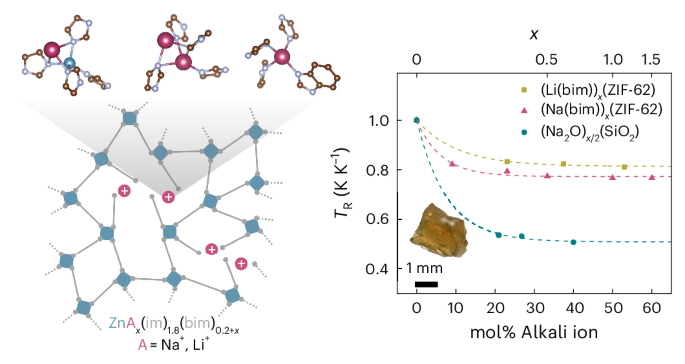
Modifying glass compositions is key to creating silicate-based glasses for technologies including optical fibres, catalytic supports, protective coatings and separation membranes. Here we extend this concept to metal–organic framework (MOF) glasses by modifying the MOF glass former ZIF-62 with Li(bim) and Na(bim) as compatible glass modifiers (benzimidazolate, bim−). Melt-quenching of physical mixtures with increasing Na(bim) content yields modified MOF glasses that exhibit a systematic decrease in the glass transition temperature (Tg), accompanied by increased liquid fragility, configurational heat capacity at Tg and density: paralleling silicate glass chemistry through partial network depolymerization. Structural and spectroscopic analysis, coupled with density-functional theory calculations, confirm that Na(bim) is incorporated homogeneously into the MOF glass framework rather than the pores and reveal the presence of undercoordinated sodium ion environments. Finally, extraction of the modifier by water treatment increases glass porosity, akin to established borosilicate glass processes. This work introduces a transferable approach for tailoring the structure and properties of MOF glasses.