

2026-07-06 愛媛大学
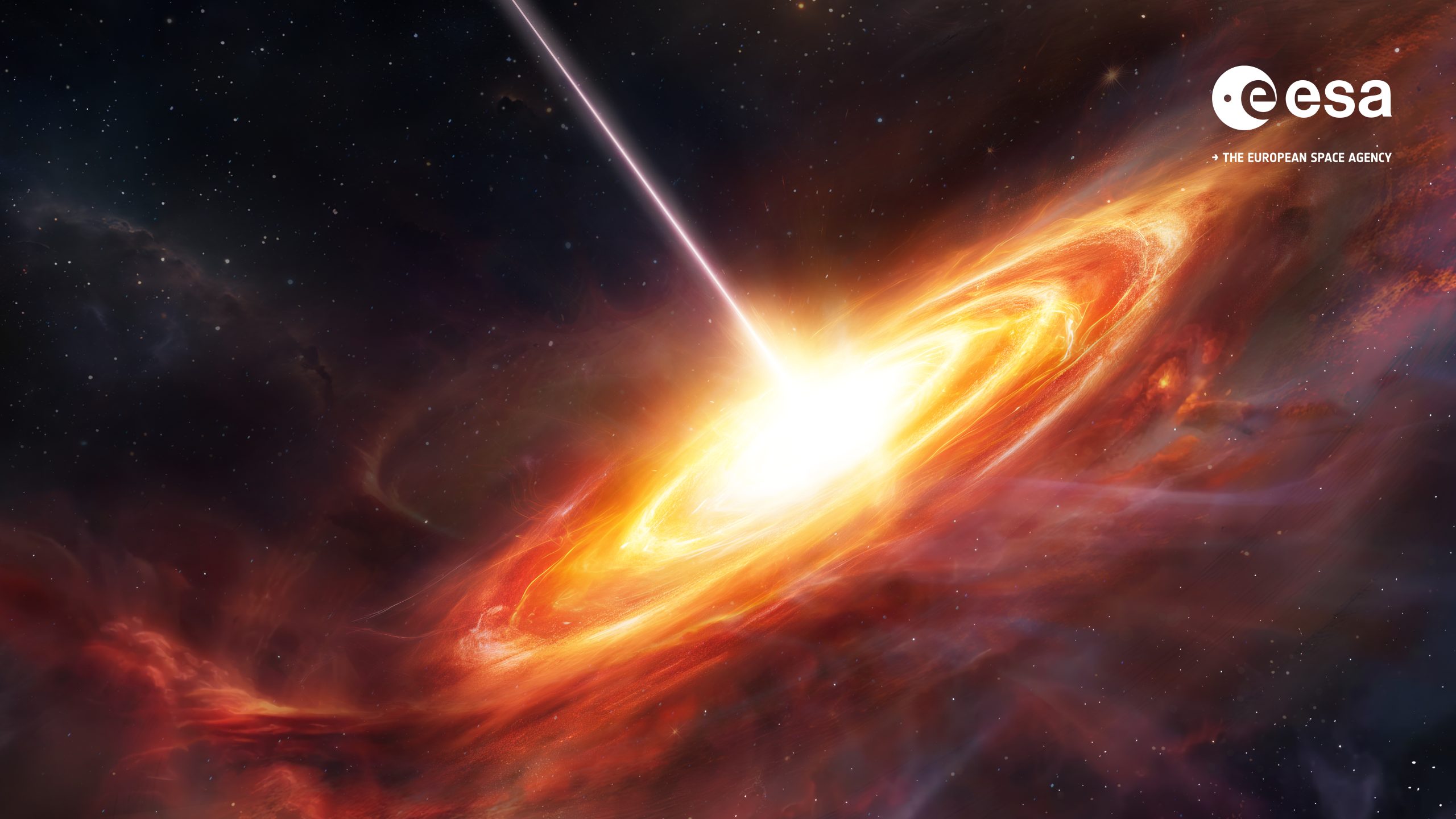
クエーサーの想像図(クレジット:ESA)
<関連情報>
- https://www.ehime-u.ac.jp/data_relese/pr_20260706_rcsce/
- https://www.aanda.org/articles/aa/full_html/2026/07/aa58883-26/aa58883-26.html
Euclid:6.6 < z < 7.8の範囲で31個の新しいクエーサーを発見 Euclid: Discovery of 31 new quasars at 6.6 < z < 7.8
D. Yang, J. F. Hennawi,, F. Guarneri,, J. Wolf, S. Belladitta,, J.-T. Schindler, A. C. N. Hughes, E. Bañados, D. J. Mortlock,, J. Yang, F. Wang, X. Fan, K. Jahnke, D. Stern, C. J. Willott, A. J. Barth, H. J. A. Rottgering, R. G. Varadaraj, R. Decarli, A.-C. Eilers,, M. Ezziati, Y. Fu,, J. Huang, X. Jin,, Y. Kang, L. N. Martinez-Ramirez,,, Y. Matsuoka, M. Onoue,, R. Pello, R. P. Remigio, W. L. Tee, B. Venemans, G. Vietri, B. Wang,, L. J. Abbo, H. Atek, S. Bisogni, S. E. I. Bosman,, R. A. A. Bowler, C. J. Conselice, F. B. Davies, C. M. Gutierrez,, Y. Harikane, K. Rubinur, C. C. Lovell,, M. Magliocchetti, J. Matthee, F. Ricci,, M. Scialpi,,, D. Scott, L. Spinoglio, F. Tarsitano,, Y. Toba,, F. Walter, J. R. Weaver, G. Zamorani, B. Altieri, A. Amara, S. Andreon, H. Aussel, C. Baccigalupi,,,, M. Baldi,,, A. Balestra, S. Bardelli, P. Battaglia, A. Biviano,, E. Branchini,,, M. Brescia,, S. Camera,,, G. Cañas-Herrera,, V. Capobianco, C. Carbone, J. Carretero,, M. Castellano, G. Castignani, S. Cavuoti,, K. C. Chambers, A. Cimatti, C. Colodro-Conde, G. Congedo, L. Conversi,, Y. Copin, F. Courbin,,, H. M. Courtois, M. Cropper, J.-C. Cuillandre, H. Degaudenzi, G. De Lucia, C. Dolding, H. Dole, M. Douspis, F. Dubath, X. Dupac, S. Dusini, S. Escoffier, M. Farina, R. Farinelli, S. Ferriol, F. Finelli,, N. Fourmanoit, M. Frailis, E. Franceschi, M. Fumana, S. Galeotta, K. George, B. Gillis, C. Giocoli,, P. Gómez-Alvarez,, J. Gracia-Carpio, A. Grazian, F. Grupp,, L. Guzzo,,, S. Gwyn, S. V. H. Haugan, H. Hoekstra, W. Holmes, I. M. Hook, F. Hormuth, A. Hornstrup,, M. Jhabvala, S. Kermiche, B. Kubik, K. Kuijken, M. Kümmel, M. Kunz, H. Kurki-Suonio,, A. M. C. Le Brun, S. Ligori, P. B. Lilje, V. Lindholm,, I. Lloro, G. Mainetti, D. Maino,,, E. Maiorano, O. Mansutti, O. Marggraf, M. Martinelli,, N. Martinet, F. Marulli,,, R. J. Massey, H. J. McCracken, E. Medinaceli, S. Mei,, Y. Mellier,, M. Meneghetti,, E. Merlin, G. Meylan, J. J. Mohr, A. Mora, M. Moresco,, L. Moscardini,,, E. Munari,, R. Nakajima, C. Neissner,, R. C. Nichol, S.-M. Niemi, C. Padilla, S. Paltani, F. Pasian, K. Pedersen, W. J. Percival,,, V. Pettorino, S. Pires, G. Polenta, M. Poncet, L. A. Popa, L. Pozzetti, G. D. Racca,, F. Raison, R. Rebolo,,, A. Renzi,, J. Rhodes, G. Riccio, H.-W. Rix, E. Romelli, M. Roncarelli, C. Rosset, B. Rusholme, R. Saglia,, Z. Sakr,,, D. Sapone, M. Sauvage, M. Schirmer, P. Schneider, T. Schrabback, A. Secroun, G. Seidel, S. Serrano,,, E. Sihvola, P. Simon, C. Sirignano,, G. Sirri, L. Stanco, J. Steinwagner, P. Tallada-Crespí,, I. Tereno,, N. Tessore, S. Toft,, R. Toledo-Moreo, F. Torradeflot,, I. Tutusaus,,, L. Valenziano,, J. Valiviita,, T. Vassallo, Y. Wang, J. Weller,, F. M. Zerbi, E. Zucca, G. Fabbian, M. Huertas-Company,,, J. Martín-Fleitas, P. Monaco,,,, V. Scottez, and M. Viel
Astronomy & Astrophysics Published:06 July 2026
DOI:https://doi.org/10.1051/0004-6361/202658883
Abstract
We report the discovery of 31 new high-z quasars in the redshift range 6.6 < z < 7.8. These quasars were selected from approximately 3000 deg2 of sky covered during the first 1.5 years of the Euclid Wide Survey, representing the initial results of the Euclid high-z quasar search. Our candidate selection employed multiple machine-learning and probabilistic techniques applied to the EuclidIE, YE, JE, and HE images, supplemented by ancillary z-band data when available. Spectroscopic follow-up observations were carried out with Keck, Magellan, and the Large Binocular Telescope (LBT). Among the new discoveries, there are 12 quasars at z ≥ 7, more than doubling the number of previously known quasars at z ≥ 7. The newly discovered quasars exhibit 21.2 < JE < 23.2 (−25.5 < M1450 < −23.6), extending quasar studies to the faint end of the quasar luminosity function (QLF) at z ≳ 7. The quasar with the highest-z, EUCL J172902.75+641018.1 at z ≈ 7.77, sets the new redshift record for the most distant quasar ever reported. These discoveries demonstrate Euclid’s transformative role in high-z quasar discovery and set the stage for future follow-up studies of the early galaxies hosting quasars, supermassive black hole growth, and the intergalactic medium in the epoch of reionisation.

