2026-07-02 京都大学
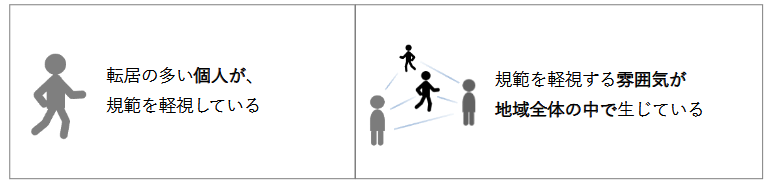
研究の問い:地域の規範が形骸化するのはどちらの影響?
<関連情報>
- https://www.kyoto-u.ac.jp/ja/research-news/2026-07-02-1
- https://www.sciencedirect.com/science/article/pii/S0264275126004191?via%3Dihub
居住移動は、協力に関する社会規範を損なう文脈的要因である:日本のコミュニティデータを用いた多層分 Residential mobility as a contextual factor undermining social norms for cooperation: Multilevel analyses of community data in Japan
Kosuke Takemura, Shintaro Fukushima, Yukiko Uchida, Satoshi Asano, Noboru Okuda
Cities Available online: 23 May 2026
DOI:https://doi.org/10.1016/j.cities.2026.107187
Highlights
- Perception of social norms is linked to cooperative behavior within a community.
- The norms-cooperation link is weak in communities with high residential mobility.
- In high-mobility communities, norms are ineffective for both movers and non-movers.
- Community-level residential mobility has a contextual effect that undermines norms.
Abstract
Social norms sustain community cooperation through sanctions against free riders. However, previous studies have argued that norms are ineffective for individuals who often relocate, because ostracism, a form of sanction, is not a threat to them. In addition to such individual-level effects, we investigated the possibility that residential mobility at the community level has unique effects. That is, a place with high residential mobility may create social contexts in which people anticipate others to disrespect norms, and as a result, people, including non-movers, may ignore norms (i.e., contextual effect). This study analyzed two separate large-scale survey datasets (total N = 7597) from Japan using multilevel modeling. We consistently found that the association between perceived norms and cooperation was weaker in communities with higher mobility, including both movers and non-movers. The findings suggest that macro-level residential mobility appears to affect the social contexts that underpin norms.