
2026-06-29 ロイヤルメルボルン工科大学(RMIT)
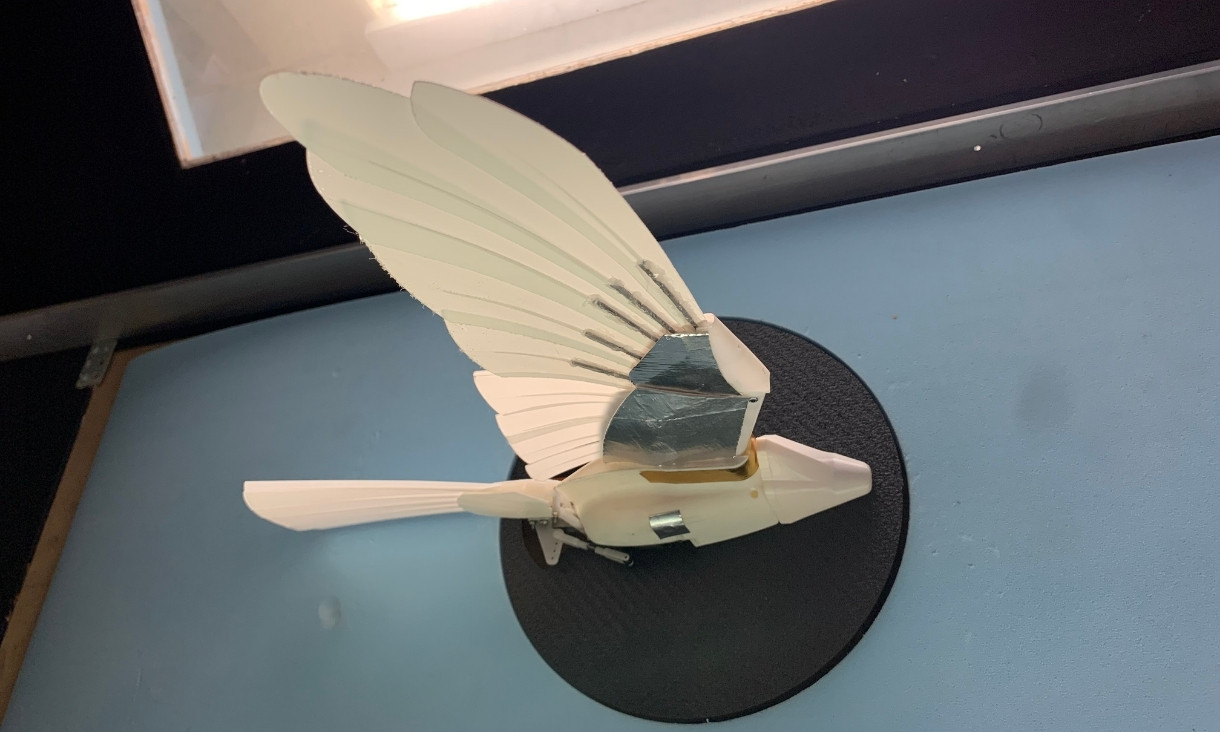
The robot replica allowed research to measure the forces involved more precisely. Image: RMIT
<関連情報>
- https://www.rmit.edu.au/news/all-news/2026/jun/kestrel-bot
- https://royalsocietypublishing.org/rsif/article/23/239/20250930/482127/Stability-and-control-benefits-of-coupled-wing-and
- https://royalsocietypublishing.org/rsif/article/23/237/20250978/481494/Bridging-the-gap-a-review-of-gust-mitigation-in
ロボットレプリカを用いて、チョウゲンボウの風上ホバリング飛行における翼と尾部の連動変形による安定性と制御上の利点を検証した Stability and control benefits of coupled wing and tail morphing in kestrel wind-hovering flight explored using a robot replica
Mario Martinez Groves-Raines;Simon Watkins;Abdulghani Mohamed;Shane Windsor
Journal of the Royal Society Interface Published:17 Jun 2026
DOI:https://doi.org/10.1098/rsif.2025.0930
Abstract
Birds control flight differently to aircraft, morphing their wings and tail to modify forces rather than relying on hinged control surfaces. Some species, such as kestrels, are more manoeuvrable than similar-sized fixed-wing uncrewed air vehicles and can fly in more turbulent wind conditions. We propose that birds achieve this advantage partly through morphing and explore specific benefits that morphing might provide versus conventional control surfaces. Focusing on kestrel flight, we examined the aerodynamic effects of morphing using a high-fidelity robot replicating the predominant motions of wind-hovering kestrels. Wind-tunnel testing assessed the impacts of wing extension, tail spread and tail incidence on force production and stability. The findings illustrate flexibility in control inputs combinations for achieving required flight forces and the ability to trim for different levels of stability through area-changing degrees of freedom. Coupled wing and tail extension improved lift while decoupling lift and pitching moment modulation, reflecting strategies used in real kestrels. Surprisingly, wing and tail morphing offered no greater control authority than conventional control surfaces, but when combined with low wing inertia, yielded superior manoeuvrability. These findings highlight the potential of combining avian-inspired morphing with low-inertia wing designs to enhance the manoeuvrability and performance of small aircraft.
ギャップを埋める:鳥類と小型無人航空機における突風緩和策のレビュー Bridging the gap: a review of gust mitigation in birds and small uncrewed aerial vehicles
Matthew Penn;Simon Watkins;Shane Windsor;Abdulghani Mohamed
Journal of the Royal Society Interface Published:29 Apr 2026
DOI:https://doi.org/10.1098/rsif.2025.0978
Abstract
Small uncrewed aerial vehicles (SUAVs) are highly vulnerable to atmospheric gusts owing to their small sizes and operation in turbulent environments. Despite similar size limitations, birds navigate the same environments with remarkable steadiness. This review surveys the range of gust mitigation strategies and mechanisms employed by birds and SUAVs. Birds integrate many different gust mitigation techniques, including separation control mechanisms, aeroelastic responses, rich sensory feedback and active control. While a similar range of gust mitigation methods has been explored for SUAVs, most remain at low technology readiness levels and have typically been studied in isolation. The exceptional steadiness of birds appears to arise from effectively harnessing a wide array of gust mitigation techniques. Achieving bird-like steadiness in SUAVs will probably require the synergy of multiple gust mitigation techniques in a single platform, while carefully balancing trade-offs between stability, mass, manoeuvrability and efficiency.

