2026-06-25 オックスフォード大学
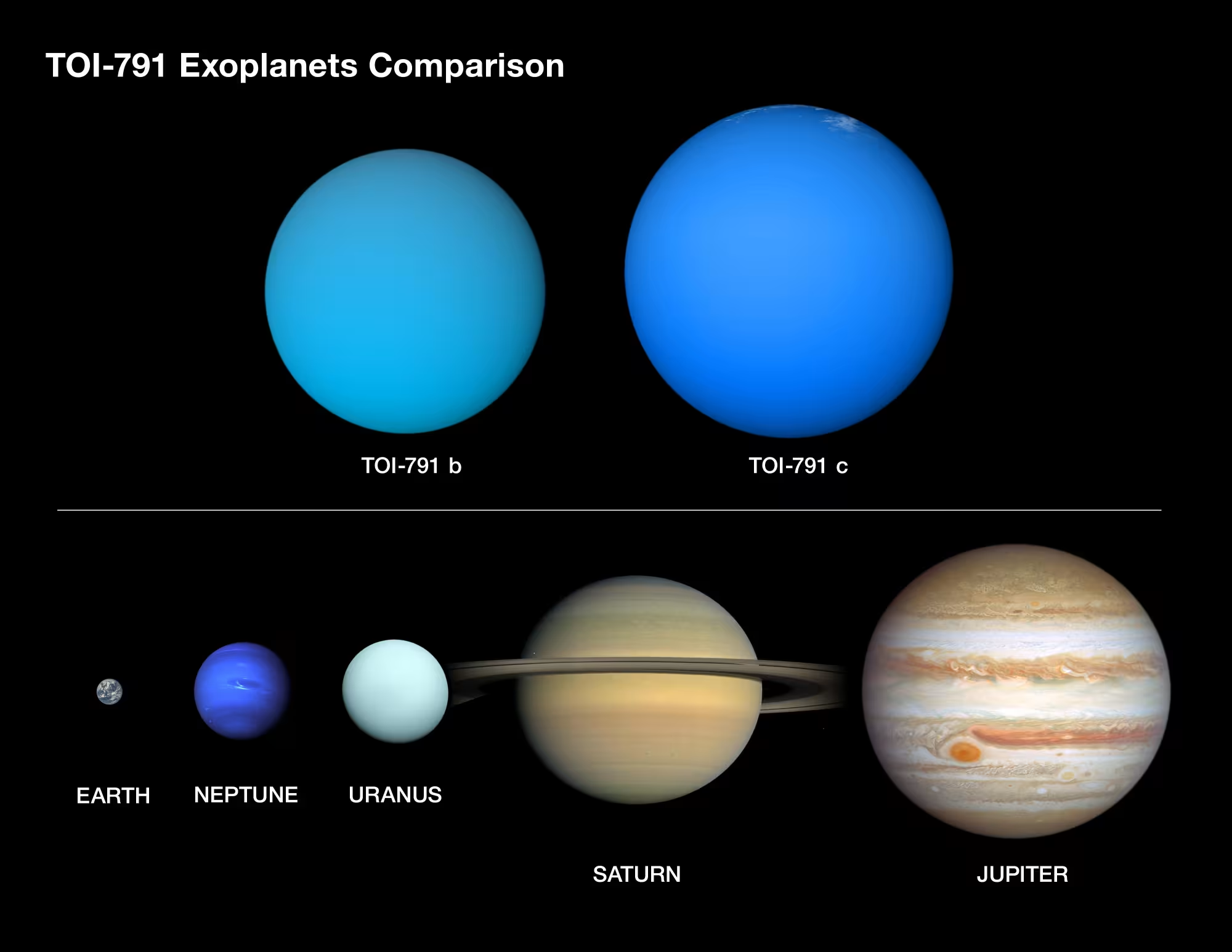
Comparison of the exoplanets in the TOI-791 system with planets in our solar system.
Image credit: NASA/Daniel Rutter. Image credit: NASA/Daniel Rutter.
<関連情報>
- https://www.ox.ac.uk/news/2026-06-24-researchers-discover-pair-of-giant-super-puff-planets-lighter-than-candy-floss
- https://academic.oup.com/mnras/article/549/4/stag864/8715235
ASTEPによる、極めて低密度な長周期木星サイズの惑星ペアがTOI-791を通過することの確認 ASTEP confirmation of a pair of long-period Jupiter-sized planets with extremely low densities transiting TOI-791
Georgina Dransfield,Antoine C Petit,Amaury H M J Triaud,Tristan Guillot,François-Xavier Schmider,Lyu Abe,Abdelkrim Agabi,Khalid Barkaoui,Thomas A Baycroft,Philippe Bendjoya,…
Monthly Notices of the Royal Astronomical Society Published:25 June 2026
DOI:https://doi.org/10.1093/mnras/stag864
ABSTRACT
Gas giant planets with periods 20<P<300 d orbiting Sun-like stars are a relatively uncommon outcome of planetary formation, and key questions about the nature and formation of this subpopulation remain unanswered. Theoretical models for the location of their formation (in situ or ex situ) and for their subsequent migration predict different outcomes in terms of planet masses and eccentricities, indicating that observations have a key role to play in disentangling their histories. In this work, we present the discovery and confirmation of a pair of long-period Jupiter-sized planets transiting an F7 star: TOI-791 b is a 0.993±0.033 RJup planet on a 139.29931+0.00011-0.00012 d orbit, and TOI-791 c, a 1.155±0.040 RJup planet on a 232.01570+0.00067-0.00071 d orbit. The two planets are within 0.07 per cent of a second-order 5:3 period commensurability leading to transit timing variations (TTVs) of up to 50 min. We confirm their planetary nature using ground-based photometry, including multiple full detections of the >11h transits of both TOI-791 b and c from Antarctica with ASTEP, making these the longest-duration transits ever observed in their entirety from the ground. Our detailed analysis of the TTV signal allows us to measure dynamical masses for both planets, which yield densities of pb=0.038±0.008gcm-3 and pc=0.047±0.006gcm-3 , indicating that TOI-791 b and c are two of the lowest density giant planets ever detected. While these measurements are robust, further follow-up is needed to fully characterize the TTV signal and the architecture of the system.