2026-06-18 合肥物質科学研究院(HFIPS)
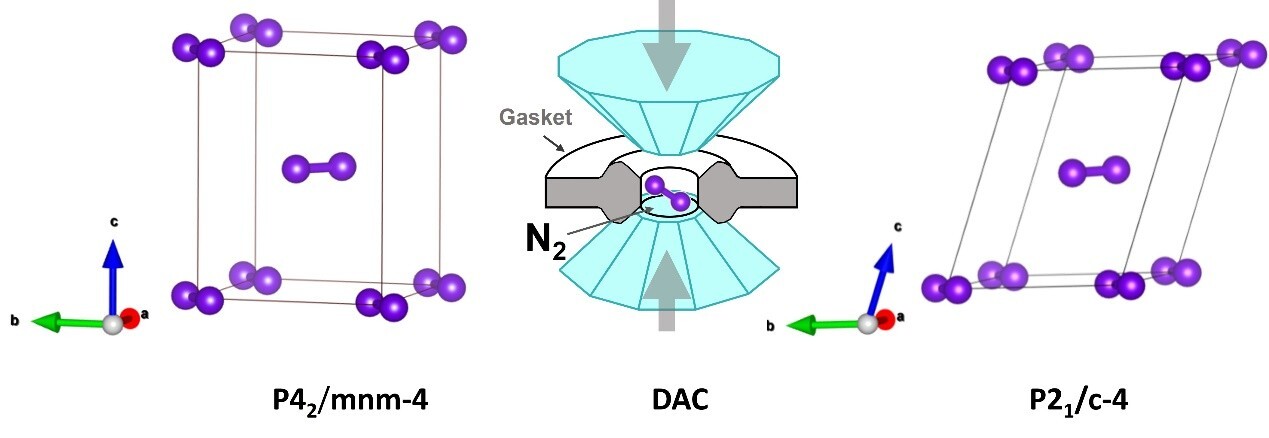
Schematic illustration of the pressure-induced structural distortion in γ-N₂, from a body-centered-cubic-like molecular arrangement to a monoclinic P2₁/c structure. (Image by LIU Xiaodi)
<関連情報>
- https://english.hf.cas.cn/nr/rn/202606/t20260618_1174321.html
- https://pubs.aip.org/aip/mre/article/11/4/047802/3391145/Revisiting-the-structural-and-optical-properties
γ – N2 の構造的および光学的特性の再検討
Revisiting the structural and optical properties of γ-N2
Jinwei Yan;Hai-An Xu;Pu Wang;Lewis J. Conway;Wan Xu;Chuansheng Hu;Zeming Qi;Xiao-Di Liu;Eugene Gregoryanz
Matter and Radiation at Extremes Published:May 13 2026
DOI:https://doi.org/10.1063/5.0315313
For decades, γ-N2 has been known to exist at very low temperatures and pressures, located in a tiny area of the nitrogen phase diagram. Recently, it was shown that γ-N2 occupies most of the P–T space usually associated with molecular phases such as δ, ɛ, and ζ, and that it plays a pivotal role in shaping nitrogen’s phase diagram. Using powder synchrotron X-ray diffraction, Raman and infrared spectroscopy, and density function theory calculations, we have investigated the structural and optical properties of γ-N2 in a wide P–T range. The combined X-ray diffraction and infrared spectroscopy results unequivocally demonstrate that γ-N2 adopts the monoclinic (P21/c space group) configuration with two N2 molecules per unit cell. It appears that the γ-N2 is structurally closely related to θ-N2, leading to both phases having very similar Raman signatures. Additionally, the Raman spectroscopy reveals a vibrational mode intensity resonance effect in both phases, caused by a strong vibrational coupling between the isotopic 15N14N and 14N2 vibrational excitations.