2026-06-09 コロンビア大学
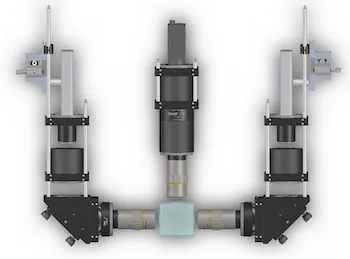
An image of a compact, projector-based light-sheet microscope (pLSM) with a SCOPE device attached to it.
<関連情報>
- https://news.columbia.edu/news/new-3d-microscope-technology-captures-high-resolution-tissue-images-fraction-cost
- https://www.nature.com/articles/s41587-026-03172-7
ハイブリッド固体・液体光学により、多様な浸漬媒体において、拡張性と高解像度を備えたライトシート顕微鏡観察が可能になる Hybrid solid−liquid optics enable scalable, high-resolution light-sheet microscopy across diverse immersion media
Cheng Gong,Pauline Affatato,Matt Fay,Sudha R. Guttikonda,Nathan J. O’Connor,Emerson Noble,Maci Heal,Benjamin Haydock,Renee Mapa,Estanislao Daniel De La Cruz,Giacomo Gattoni,Johanna E. Kowalko,Maria Antonietta Tosches,Charles R. Gerfen,Rene Hen,Christopher D. Makinson,Hanina Hibshoosh,Jack R. Glaser & Raju Tomer
Nature Technology Published:09 June 2026
DOI:https://doi.org/10.1038/s41587-026-03172-7
Abstract
Many data-driven approaches rely on scalable and affordable three-dimensional (3D) imaging across subcellular to organ scales. Although advances in tissue clearing, expansion microscopy and light-sheet microscopy (LSM) have enabled high-resolution imaging of intact specimens, scalability in sample size, throughput and accessibility remains fundamentally limited by detection optics. Here we introduce hybrid solid−liquid optics (HySIL), a flexible refractive design framework in which a solid optical element and a refractive index (RI)-matched liquid function as a continuous optical system for wavefront correction and numerical aperture enhancement. We implement this framework as SCOPE and Super-SCOPE, enabling submicron-resolution, aberration-corrected LSM using long-working-distance air objectives. We demonstrate high-resolution volumetric imaging across diverse biological contexts, including cleared and expanded mouse, salamander and cavefish brains, human induced pluripotent stem cell (iPSC)-derived brain organoids and large intact human tissues for 3D histopathology. By combining enhanced optical performance with low-cost, long-working-distance and multi-immersion compatibility, HySIL provides an accessible and scalable foundation for next-generation volumetric imaging and data-driven biological discovery.