2026-06-02 ジョージア工科大学
<関連情報>
- https://research.gatech.edu/georgia-tech-students-create-chemical-safety-model-everyday-exposures
- https://pubs.acs.org/doi/10.1021/acs.chas.6c00021
一般的な安全用途における密閉空間内の時間依存化学物質濃度のモデリング Modeling Time-Dependent Chemical Concentrations in Confined Spaces for General Safety Applications
Diya Godavarti,Waynell Simbafo,John Pederson,Jenny Houlroyd,and Pamela Pollet
ACS Chemical Health & Safety Published :April 15, 2026
DOI:https://doi.org/10.1021/acs.chas.6c00021
Abstract
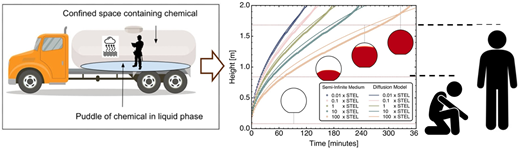
Enclosed spaces with little to no ventilation present significant chemical exposure risks in many occupational environments. This study develops and verifies an open-source computational fluid dynamics (CFD)-based diffusion model to predict vapor-phase transient concentrations as a function of time and geometry-specific context. Our contribution is to make foundational diffusion-based exposure models accurate, reliable, and broadly accessible to nonspecialists. A combined mesh and time-step refinement study was performed to evaluate the convergence of observables (i.e., concentrations and time) for diffusion-based simulations. Simulations tracked vapor front progression of benzene, a carcinogen, and our selected model compound using its OSHA Short-Term Exposure Limit (STEL) of 5 ppm in the headspace of a truck tank. We compare our model with results from the analytical semi-infinite medium solution. The diffusion model aligned closely with the analytical solution at early times but diverged later due to transverse diffusion resulting from the space-specific geometry. Additionally, we report analyses that quantified deviations as well as posture-dependent exposure timelines. Sensitivity analyses of varying temperatures and liquid pool heights were also performed. These findings underscore the importance of transient, geometry-conscious modeling for risk assessment, complementing and informing physical sampling needs, and ventilation strategies. By relying on open-source software like OpenFOAM and shareable code, this work expands the CFD-based exposure modeling beyond specialized commercial environments, moving toward a more practical use in public and noncontrolled situations.