
2026-06-04 大阪公立大学
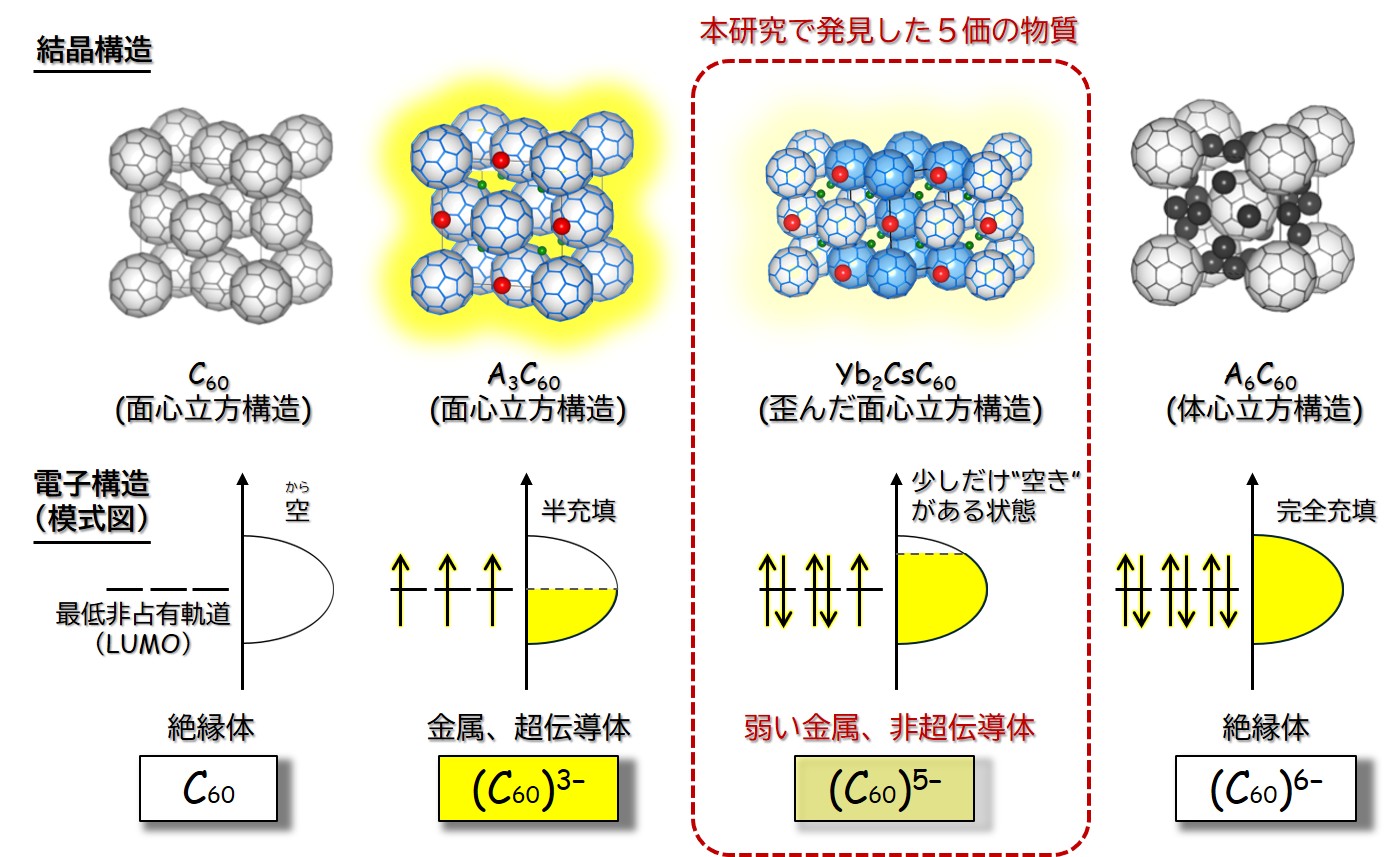
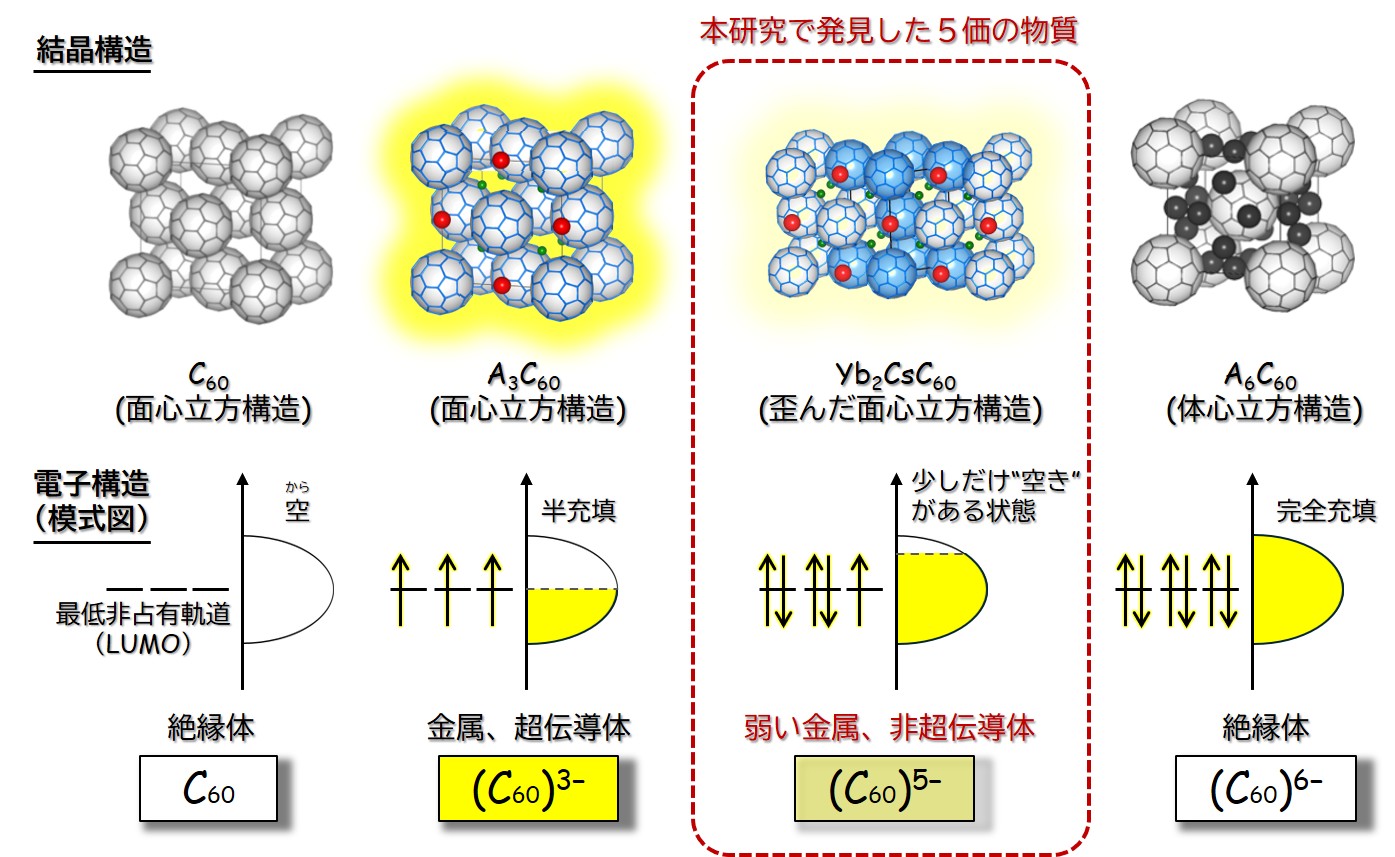
図 “中途半端な価数”のフラーレン化合物の合成・結晶構造・電子構造
<関連情報>
- https://www.omu.ac.jp/info/research_news/entry-24235.html
- https://www.nature.com/articles/s41467-026-73095-z
単一ホール多バンドp軌道分子系における金属状態の存続 Survival of the metallic state in a single-hole multiband p-orbital molecular system
Keisuke Matsui,Ryan A. Klein,Naoya Yoshikane,John Arvanitidis,Matjaž Gomilšek,Urh Klopčič,Shogo Kawaguchi,Hitoshi Yamaoka,Nozomu Hiraoka,Hirofumi Ishii,Qiang Zhang,Shigeo Mori,Hiroki Ishibashi,Yoshiki Kubota,Craig M. Brown,Denis Arčon & Kosmas Prassides
Nature Communications Published:26 May 2026
DOI:https://doi.org/10.1038/s41467-026-73095-z
Abstract
Strong correlations and ferromagnetic Hund’s coupling lead to diverse electronic phenomena in transition-metal oxides that sensitively depend on the d-orbital electron filling. Fullerides, their p-electron counterparts, exhibit effective antiferromagnetic Hund’s coupling in a different energy range. At half-filling (n = 3, three electrons in triply degenerate orbitals), both d– and p-electron systems are Mott insulators due to strong correlations and Hund’s coupling. Away from half-filling, in single-electron/hole (n = 1,5) d-orbital systems, Hund’s coupling opposes the correlations, reducing the Mott gap and allowing survival of metallicity. Here we report a single-hole multiorbital correlated p-electron system, orthorhombic-structured Yb2CsC60 comprising pentavalent C605− anions, which also exhibits a robust metallic state with no Mott transition, just like in the metastable single-electron cubic-structured CsC60. We assert that particle−hole symmetry holds well in (n = 1,5) fullerides and that their p-electron-derived states are analogous to those in d-orbital solids, providing impetus for further study of these correlated systems.

