2026-06-02 中国科学院(CAS)
<関連情報>
- https://english.cas.cn/newsroom/research-news/202606/t20260602_1160337.shtml
- https://academic.oup.com/nsr/article/13/9/nwag237/8660110?login=false
土壌炭素の滞留時間は、世界の河川における溶存有機物の年齢を規定する Soil carbon residence time regulates the age of dissolved organic matter in global rivers
Zhaohui Liu,Yongqiang Zhou,Gerard Rocher-Ros,Joshua F Dean,Jack J Middelburg,Pierre Regnier,Jan Karlsson,Liwei Zhang,Weipeng Lin,Chenglong Wang,…
National Science Review Published:21 April 2026
DOI:https://doi.org/10.1093/nsr/nwag237
ABSTRACT
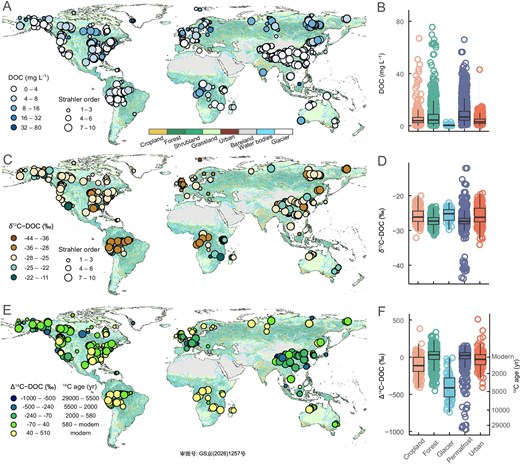
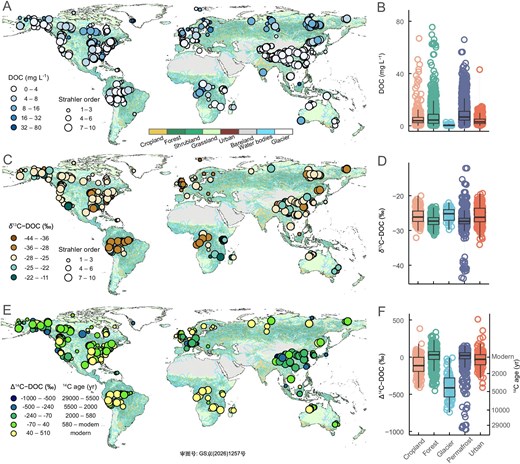
Riverine dissolved organic carbon (DOC) constitutes a pivotal component in the Earth’s carbon cycle, yet little is known about the global patterns, sources, and factors governing lotic DOC. Here, we integrate a global dataset and employ machine learning to generate a global atlas of riverine DOC concentration and its radiocarbon (Δ14C) and stable-carbon (δ13C) isotopic signatures. Globally, riverine DOC has an average Δ14C value of –22.5‰ ± 144.0‰ (radiocarbon age of 221 years), with fossil carbon contributing a minor fraction (6.7% ± 3.0%). Terrestrial and autochthonous riverine production are the dominant DOC sources (>80%) at the global scale, with contemporary terrestrial DOC predominant in tropical rivers and within-river production prominent in those within temperate and semi-arid regions. Rivers draining high-latitude regions and high-elevation sites have the lowest Δ14C values (–353‰ to –78‰; ages between 3400 and 600 years). River Δ14C-DOC values correlate with soil organic carbon Δ14C values, but river DOC has much higher Δ14C values than subsurface soils indicating that riverine DOC originates from surface rather than subsurface soils. Because warming mobilizes aged organic carbon from permafrost soils, export to and processing of old carbon in recipient aquatic systems may accelerate with climate change.