2026-05-25 大阪公立大学
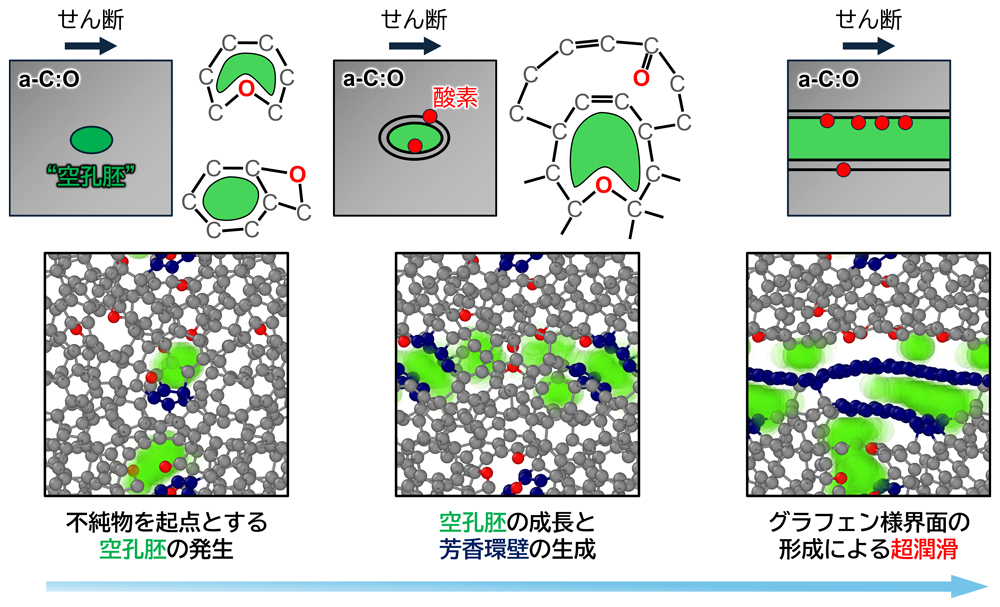
図1 せん断誘起表面芳香族化による超潤滑界面の形成
空孔胚※7の発生からグラフェン様界面形成までのメカニズム
<関連情報>
- https://www.omu.ac.jp/info/research_news/entry-24130.html
- https://advanced.onlinelibrary.wiley.com/doi/10.1002/advs.75566
非晶質炭素におけるせん断誘起による芳香族超低摩擦界面の出現:化学的不純物と原子スケールのメカニズムの誘発 Shear-Induced Emergence of Aromatic Superlow-Friction Interfaces in Amorphous Carbon: Triggering Chemical Impurities and Atomic-Scale Mechanisms
Takuya Kuwahara, Koki Horiguchi, Leonhard Mayrhofer, Gianpietro Moras, Michael Moseler
Advanced Science Published: 25 May 2026
DOI:https://doi.org/10.1002/advs.75566
ABSTRACT
Incommensurate graphitic interfaces represent an archetypical tribological system to achieve superlow friction. They are currently realized by molecular deposition or lubrication-triggered, in situ formation of graphitic nanolayers. An alternative route exploits shear-induced aromatization of amorphous carbon (a-C). This process occurs directly at surface asperity contacts, relying on chemical impurities like hydrogen and oxygen. Despite the potential of this approach, the lack of mechanistic knowledge, particularly on the role of impurities, is an obstacle to its development and application. To address these gaps, we undertake a systematic simulation study consisting of 1,000 1-ns-long quantum-mechanical molecular dynamics trajectories of sheared a-C with and without impurities. No aromatic interfaces emerge for four-valent systems like pure or silicon-doped a-C. However, shear-induced aromatization is consistently observed for impurities with valency lower than four. These cause the formation of voids surrounded preferentially by sp2-hybridized carbon atoms. Upon plastic flow, they stabilize long-living cavities that evolve into passivated interfaces, rich in polycyclic aromatic structures. The process is driven by shear localization, while passivation by low-valent impurities prevents reformation of sp3-hybridized domains. This study provides the first comprehensive screening of chemical elements triggering shear-induced carbon aromatization and is a step forward toward the design of self-forming and self-healing, superlubric carbon interfaces.