2026-05-21 スイス連邦工科大学ローザンヌ校(EPFL)
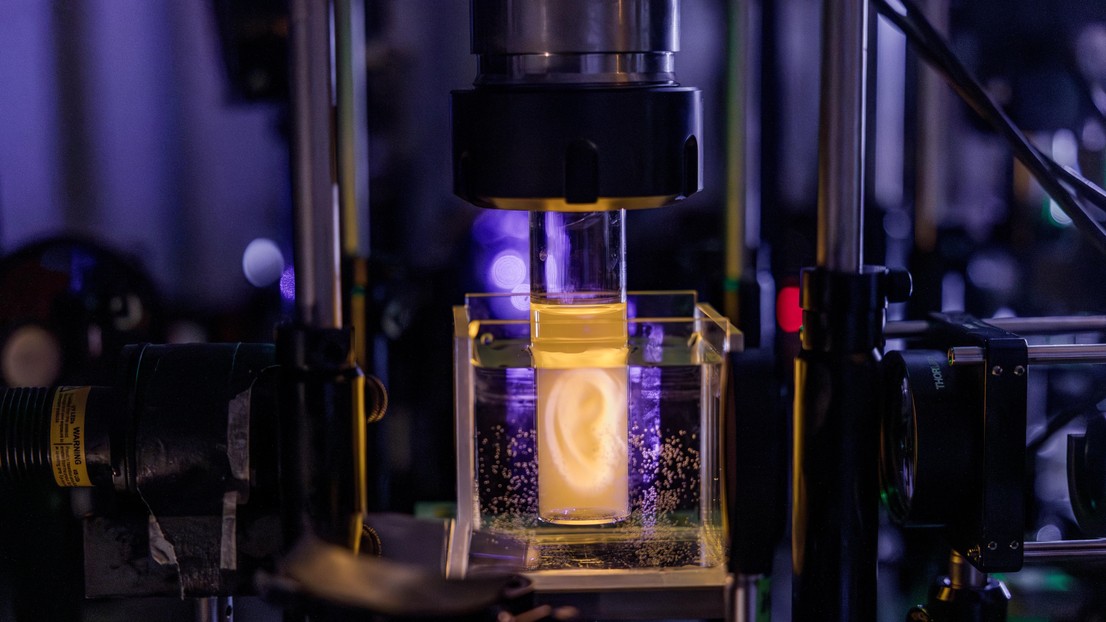
Holographic projection of a human ear model on a sample vial. 2026 Adrien Buttier/EPFL CC BY SA
<関連情報>
- https://actu.epfl.ch/news/3d-printing-tissue-like-structures-with-light-3/
- https://www.nature.com/articles/s41377-026-02331-4
- https://tiisys.com/blog/2025/02/18/post-161294/
位相光変調器を用いた高効率マルチスケールホログラフィック体積3Dプリンティング High-efficiency multi-scale holographic volumetric 3D printing with a phase light modulator
Maria Isabel Álvarez-Castaño,Riccardo Rizzo,Viola Sgarminato,Ye Pu & Christophe Moser
Light:Science & Applications Published:19 May 2026
DOI:https://doi.org/10.1038/s41377-026-02331-4
Abstract
Light-based 3D printing with photocurable resins enables the rapid fabrication of complex structures with high resolution and fidelity. Tomographic Volumetric Additive Manufacturing (TVAM) employs a digital micromirror device (DMD) to project amplitude light patterns into rotating resin volumes, producing 3D geometries through photopolymerization. Typically, the light projection efficiency in such binary amplitude modulator-based systems is below a few percent. Recent advancements introduced phase encoding in TVAM using binary amplitude modulators and the Lee Hologram method, increasing axial control and boosting light efficiency to about 10%. In this work, we present the first 3D printing platform utilizing a phase light modulator (PLM), based on an array of micro-electro-mechanical piston mirrors. Compared to amplitude encoding, phase encoding with the PLM yields a 70-fold increase in laser power efficiency. By coupling this efficient light engine with a speckle reduction method in holographic volumetric additive manufacturing (HoloVAM), we experimentally demonstrate printing 3D objects across different scales from hundreds of micrometers to centimeters and with various materials from acrylate-based resins to soft hydrogels, including cell-laden hydrogels with a concentration of 1 million cells per mL. Micro-CT revealed a ∼30.3μm as the smallest positive feature printed. Moreover, we introduce the use of gelatin Thiol/Norbornene as a material for printing with the Holographic VAM technique, which allows us to print large-scale objects (up to (3×3×4㎝3 within 2 minutes using only a 150 mW laser diode. The PLM opens up new avenues in volumetric AM for holographic techniques using low-cost single-mode laser diodes.