2026-05-20 ロッキーズ国立研究所(NLR)
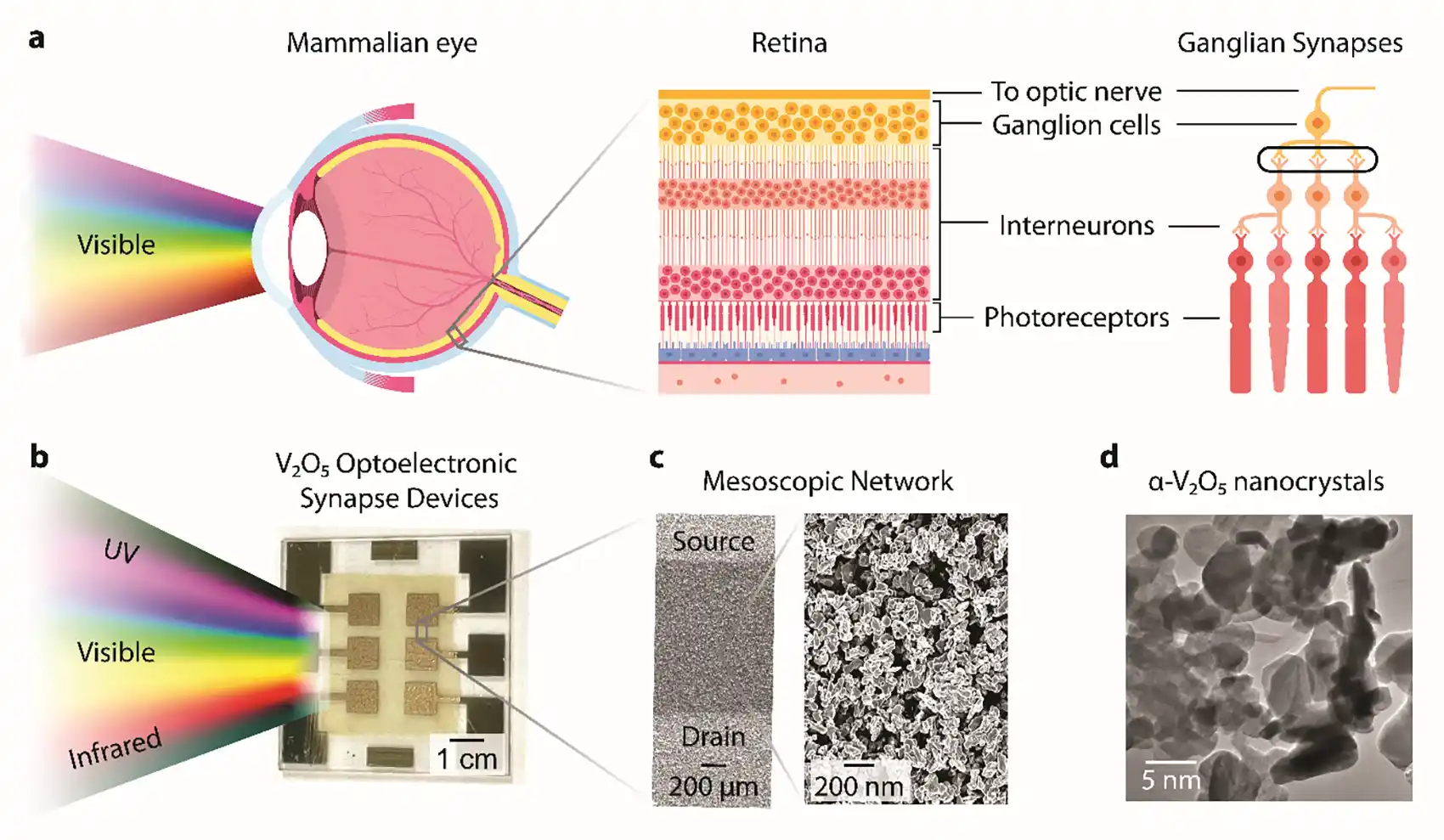
When light hits the eye, it induces an electric charge that is trapped by cells. The cells interpret the energy, amplitude, and duration of that charge to create an image in the mind. Vanadium pentoxide does something similar: It entraps the charge, which can be read to reconstruct the image. Illustration by National Laboratory of the Rockies
<関連情報>
- https://www.nlr.gov/news/detail/program/2026/scientists-shine-light-on-materials-that-remember
- https://advanced.onlinelibrary.wiley.com/doi/10.1002/adfm.202510479
広帯域光電子シナプスのためのメソスコピックV2O5における層間励起子ポーラロン Interlayer Exciton Polarons in Mesoscopic V2O5 for Broadband Optoelectronic Synapses
Thanh Luan Phan, Jialu Li, Swagata Acharya, Alice R. Giem, Md Azimul Haque, Srikrishna Sagar, Dimitar Pashov, Savio Laricchia, Elisa M. Miller, Michelle A. Smeaton …
Advanced Functional Materials Published: 20 November 2025
DOI:https://doi.org/10.1002/adfm.202510479
Abstract
Persistent photoconductivity and optoelectronic synaptic behavior are demonstrated in solution-processed mesoscopic α-phase vanadium pentoxide (V2O5) thin films. First-principles simulations coupled with the two-site Holstein polaron hopping model show that vacancies at the terminal oxygen position lead to long recombination times because photoexcited electrons and holes reside on different layers separated by the van der Waals gap, forming a weakly coupled interlayer exciton polaron. Mid-gap polaronic states also significantly broaden the photoresponse of the films to span across visible and infrared wavelengths. By controlling the amplitude/intensity, duration, and/or number of optical pulses, tunable optoelectronic memory functions, such as short-term and long-term plasticity, are experimentally established in V2O5-based optoelectronic synapses. Device fabrication was extended to mechanically flexible ultrathin glass substrates. Flexible optoelectronic synapses maintained high performance after 150 bending cycles.