2026-05-20 NASA
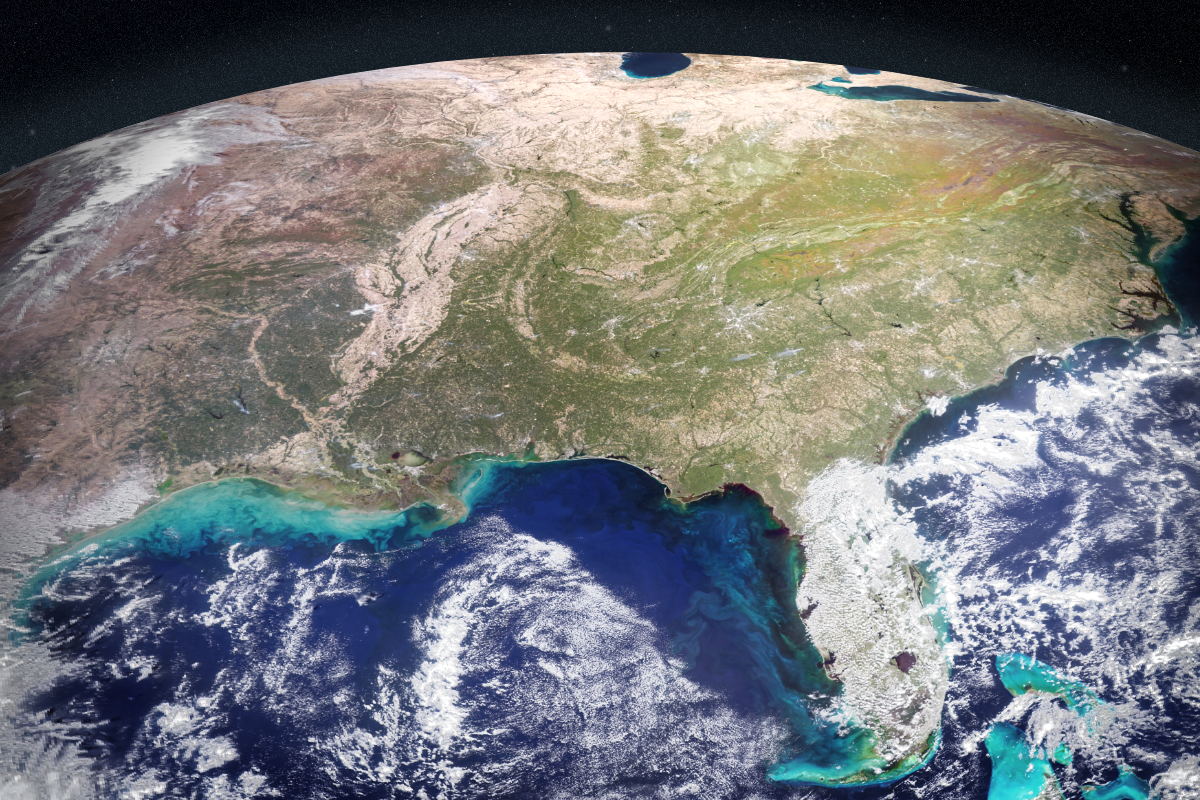
Green swirls of microscopic algae (phytoplankton) are visible off the U.S. Gulf Coast in this image captured Oct. 21, 2024, by the Ocean Color Instrument on NASA’s PACE satellite. The sensor also observed autumn leaf colors, visible as a reddish streak, to the northeast. NASA
<関連情報>
- https://www.nasa.gov/science-research/earth-science/nasa-developed-ai-could-help-track-harmful-algae/
- https://agupubs.onlinelibrary.wiley.com/doi/10.1029/2025EA004881
自己教師あり学習と階層型深層学習を用いた、有害藻類ブルーム監視のためのマルチスペクトルおよびハイパースペクトル衛星データの融合 Fusing Multi- and Hyperspectral Satellite Data for Harmful Algal Bloom Monitoring With Self-Supervised and Hierarchical Deep Learning
Nicholas J. LaHaye, Kelly M. Luis, Michelle M. Gierach
Earth and Space Science Published: 18 May 2026
DOI:https://doi.org/10.1029/2025EA004881
Abstract
We present a self-supervised machine learning framework for detecting and mapping the severity and speciation of harmful algal blooms (HABs) using multi-sensor satellite data. By fusing reflectance data from operational polar-orbiting satellite-based instruments (VIIRS, MODIS, OLCI, and OCI) with TROPOMI solar-induced fluorescence (SIF), our framework, called SIT-FUSE, generates HAB severity and speciation products without requiring per-instrument labeled data sets. The framework employs self-supervised representation learning and hierarchical deep clustering to segment phytoplankton cell abundance and species into interpretable classes, validated against in situ data from the Gulf of Mexico and Southern California (2018–2025). Results show strong agreement with total phytoplankton, Karena brevis and Pseudo-nitzschia spp. measurements. This work advances scalable HAB monitoring in environments where ground truth observations are limited, while enabling exploratory analysis via hierarchical embeddings – a critical step toward operationalizing self-supervised learning for global aquatic biogeochemistry.
Plain Language Summary
Harmful algal blooms (HABs) are increases in the abundance of algae in oceans and lakes that can harm people, animals, and the environment. While monitoring these blooms is essential for protecting public health, fisheries, and coastal economies, blooms can appear quickly and change rapidly. Traditional satellite-based monitoring methods require many matchups with ground-based measurements and either custom algorithms for each instrument or algorithm parameter updates for each new instrument, making them time-consuming and expensive to develop. This paper introduces a new approach for monitoring, using a flexible software framework called Segmentation, Instance Tracking, and data Fusion Using multi-SEnsor imagery (SIT-FUSE). SIT-FUSE uses artificial intelligence to automatically detect, track, and map HABs by combining information from multiple types of satellite sensors, including both standard and state-of-the-art instruments. Unlike previous methods, SIT-FUSE can work with little to no pre-existing labeled data, while centering the subject matter experts in the modeling and validation processes. It can also merge data from different satellites to create more detailed and frequent maps of a bloom’s evolution and its severity, and even distinguish between phytoplankton species. The system successfully identified and mapped HABs, including specific harmful species, and performed well even in complex coastal waters. By using SIT-FUSE, scientists and managers can obtain accurate, timely information on HABs for societal and ecosystem benefits.