2026-05-09 中国科学院(CAS)
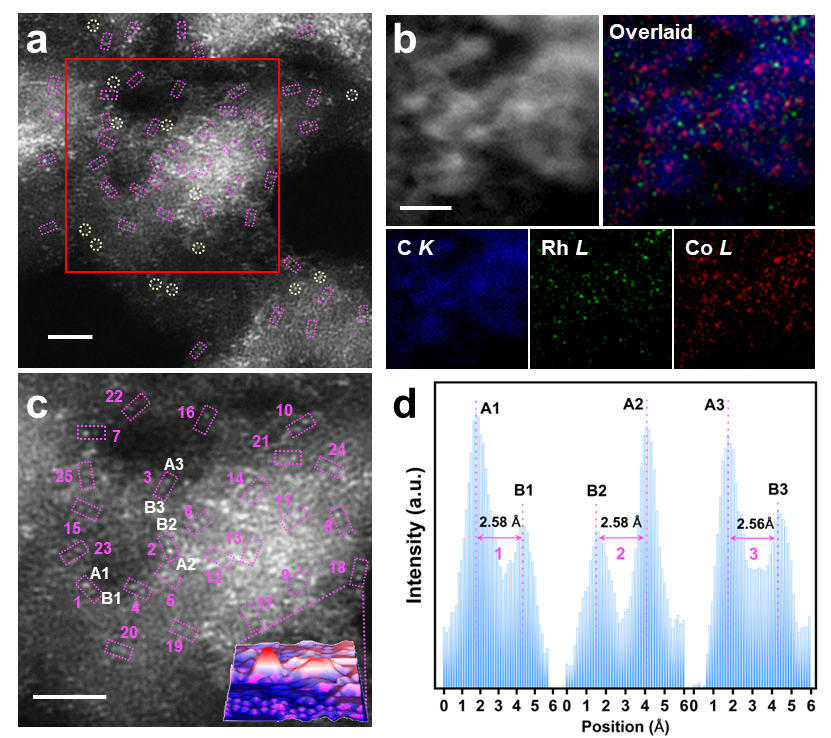
Catalyst structural characterization. (a‑c) HAADF-STEM images, (d) interatomic distance distribution. (Image by IMR)
<関連情報>
- https://english.cas.cn/newsroom/research-news/202605/t20260511_1159106.shtml
- https://www.nature.com/articles/s41467-026-69778-2
ニトリル水素化反応を相乗的に促進する二原子Rh-Co触媒 Dual-atom Rh-Co catalysts for synergistically boosting nitrile hydrogenation
Jiawei Chen,Hongqiu Chen,Xiangbin Cai,Yue Wang,Mi Peng,Bo Sun,Jiangyong Diao,Geng Sun,Ding Ma & Hongyang Liu
Nature Communications Published:25 March 2026
DOI:https://doi.org/10.1038/s41467-026-69778-2 Unedited version
Abstract
Single-atom catalysts have found widespread application in selective hydrogenation reactions partially due to their well-defined active site structures, which ensure exceptional chemical selectivity. However, the limited binding sites on single-atom catalysts hinder their application in hydrogenating larger multidentate substrates (e.g., benzonitrile). In this work, we introduced a heteronuclear Rh-Co dual-atom catalyst stabilized on the defective graphene supports (Rh1Co1/ND@G), which resolves the activity-selectivity trade-off in nitrile hydrogenation reaction. The Rh1 site primarily activates H2, whereas the Co1 site synergistically optimizes the adsorption of benzonitrile. The cooperative interaction between Rh-Co dual sites enhances the activation of the C ≡ N bond, significantly reducing the apparent activation energy compared to Rh SACs. The Rh1Co1/ND@G catalyst achieves exceptional performance under mild reaction conditions, delivering a TOF of 4068 h-1 with >98% dibenzylamine selectivity, surpassing all previous reported heterogeneous catalysts. Remarkably, the Rh1Co1/ND@G catalyst still maintains robust catalytic performance even after 12 cycles. This work not only presents a breakthrough in dual-atom catalyst design for nitrile hydrogenation, but also opens an avenue for developing high-performance industrial hydrogenation catalysts.