2026-05-11 ペンシルベニア州立大学(Penn State)
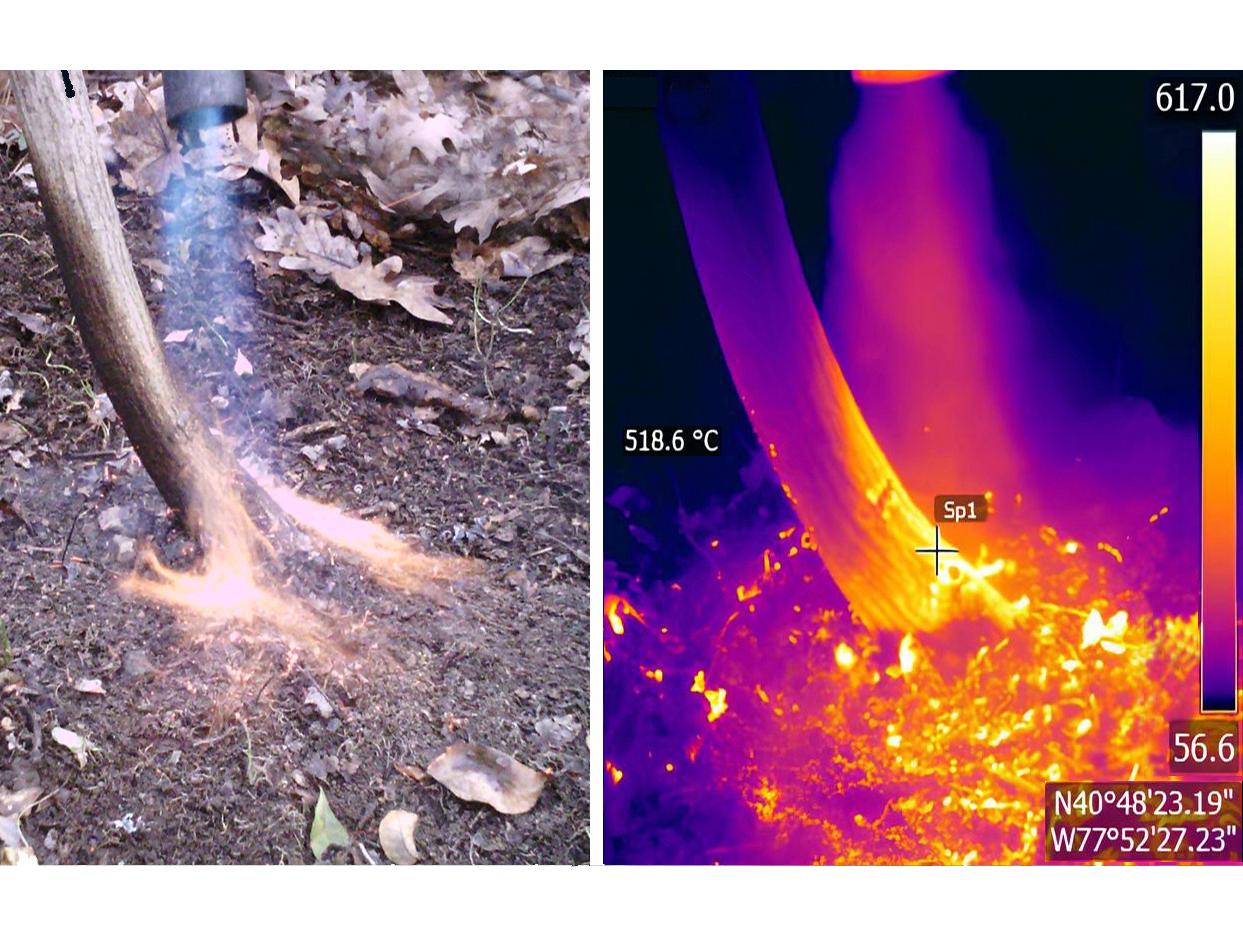
These images show two different views of a targeted heating experiment: At left, a researcher using a 10,000 BTU torch applies heat to the base of an invasive shrub, resulting in scorch; on the right, the results of that heating are shown in a thermal image captured with a FLIR camera — which detects infrared energy rather than visible light, converting it into a graphic that shows temperature differences. Credit: Arun Regmi / Penn State. All Rights Reserved.
<関連情報>
- https://www.psu.edu/news/research/story/scorched-shrubs-sprout-anew-researchers-find-controlled-fire-study
- https://esajournals.onlinelibrary.wiley.com/doi/full/10.1002/ecs2.70531
米国東部落葉樹林における、火災による損傷に対する侵入性低木の反応:損傷が大きいほど死亡率は低くなるのか? Response of invasive shrubs to fire-induced injury in eastern U.S. deciduous forests: Does more injury mean less death?
Arun Regmi, Jesse K. Kreye
Ecosphere Published: 16 February 2026
DOI:https://doi.org/10.1002/ecs2.70531
Abstract
Invasive shrubs are increasingly altering ecosystem structure and reducing biodiversity in eastern deciduous forests of North America. Among the most aggressive invaders are Euonymus alatus (burning bush) and Ligustrum obtusifolium (border privet), both were introduced from East Asia in the 19th century. These species form dense thickets and mid-story that displace native flora and disrupt ecological processes. While mechanical and chemical control methods exist, they are often costly, labor-intensive, or environmentally limiting. Prescribed fire is being more widely used as a control method, but the response of these invasive shrubs to burning is not fully understood. This study examines the response of both species to targeted heat injuries to better understand the efficacy of burning as a control method. We applied three burning treatments using a propane torch: basal heating at varying durations (5, 20, and 35 s), crown (foliar) heating, and combinations of each of these treatments. Crown heating alone did not result in any mortality. Longer basal heating durations significantly increased both mortality and sprouting likelihood in both species, although larger stem diameters increased their resilience. The longest (35 s) basal heating caused the greatest mortality, unsurprisingly, but when foliar heating was combined with basal heating, shrubs were actually less likely to die but resprout following treatment. A follow-up assessment, three years post-treatment, showed increased delayed mortality, indicating the importance of long-term monitoring. Findings suggest that long residency times during burning may be necessary to control E. alatus and L. obtusifolium and that the physiological response to varying types of heat injury from fire is not well understood.