2026-05-07 コペンハーゲン大学(UCPH)
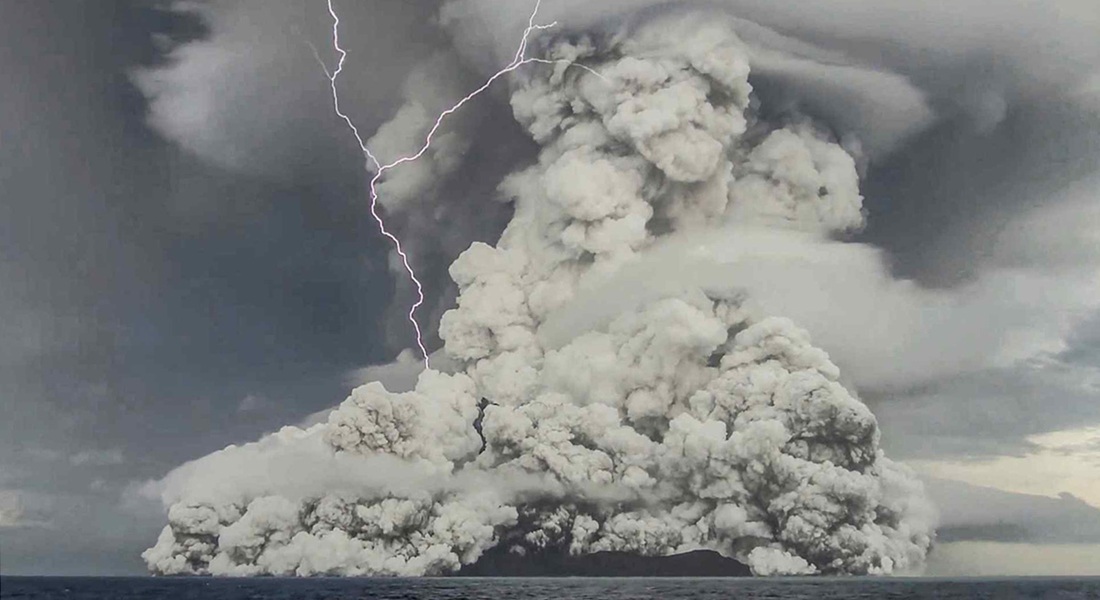
The Hunga Tonga–Hunga Ha’apai-volcanic eruption on 15 january 2022. Image taken from a video of the eruption. Source: Tonga Geological Services
<関連情報>
- https://news.ku.dk/all_news/2026/05/scientists-stunned-volcano-cleans-up-after-itself-by-removing-methane-from-the-air/
- https://www.nature.com/articles/s41467-026-72191-4
フンガ・トンガ・フンガ・ハアパイ噴火後の成層圏プルームに適用されたメタン酸化促進の衛星定量化 Satellite quantification of enhanced methane oxidation applied to the stratospheric plume following Hunga Tonga-Hunga Ha’apai eruption
Maarten M.J.W. van Herpen,Isabelle De Smedt,Daphne Meidan,Alfonso Saiz-Lopez,Matthew S. Johnson,Thomas Röckmann & Jos de Laat
Nature Communications Published:07 May 2026
DOI:https://doi.org/10.1038/s41467-026-72191-4
Abstract
Methane is a powerful greenhouse gas whose atmospheric sink remains uncertain, and emerging strategies to enhance its removal will require quantification and monitoring to verify any hypothetical future methane removal. Here we present satellite quantification of enhanced atmospheric methane oxidation, based on TROPOMI observations of a short-lived intermediate in methane oxidation, HCHO. We find a large HCHO enhancement of up to 12 ppb±10% at 30 km altitude, in the plume from the Hunga Tonga-Hunga Ha’apai eruption, persisting for ten days or more, and also explaining its low BrO levels. Total methane oxidation is 900 ± 220 Mg/day, suggesting at least 330 Gg of volcanic methane was injected into the stratosphere. The observed methane oxidation requires an estimated ongoing primary production of 2-5 Gg Cl per day that appears unexplained by known mechanisms. We show that chlorine production by iron-chloride photochemistry in sulfate-coated volcanic ash is a plausible mechanism, even outside the marine boundary layer. This method of measuring methane loss using formaldehyde can be sufficiently sensitive to quantify the impact of hypothetical future enhanced atmospheric methane oxidation approaches.