2026-04-20 沖縄科学技術大学院大学
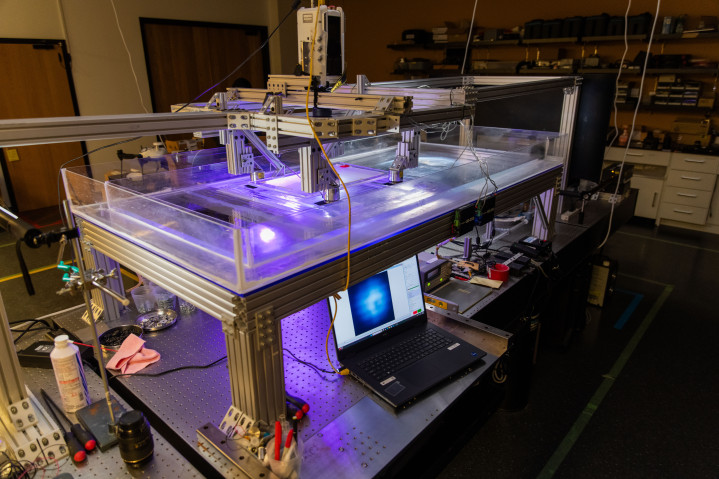
研究チームは、水面の波パターンを検出するため、上部に高速カメラを備えた特注の水槽を製作した。
© アンドリュー・スコット(OIST)
<関連情報>
- https://www.oist.jp/ja/news-center/news/2026/4/20/making-waves-water-simulation-famous-quantum-effect-reveals-unexpected-patterns
- https://www.nature.com/articles/s42005-026-02603-w
回転する流体中の定常波を通して可視化されるトポロジー Topology made visible through standing waves in a spinning fluid
Aditya Singh,Jonas Rønning,Chien-Chia Liu,Luiza Angheluta,Andres Concha & Mahesh M. Bandi
Communications Physics Published:20 April 2026
DOI:https://doi.org/10.1038/s42005-026-02603-w
Abstract
Wave-topology interactions underlie phenomena across physics, from condensed matter to cosmology, with the Aharonov-Bohm (AB) effect providing a paradigmatic example. Classical analogues in fluid dynamics have shown that travelling surface waves scattered off vortices develop wavefront dislocations, with topological effects studied close to the vortex core. Here, we demonstrate that standing surface waves scattered by a single vortex give rise to global nodal structures – lines of zero wave amplitude – whose number is quantized, and may oscillate in time. This behaviour reveals a non-local topological response, in contrast with previously reported, spatially confined interactions. Our findings establish hydrodynamics as a versatile platform for exploring wave-topology interplay and quantum interference phenomena, such as AB caging and topological localization, with potential implications for photonic, acoustic, and quantum metamaterials.