2026-04-16 中国科学院(CAS)
<関連情報>
- https://english.cas.cn/newsroom/research-news/202604/t20260415_1156315.shtml
- https://www.nature.com/articles/s41586-026-10324-x
イメージングインターフェース制御によるバルク酸素スピルオーバー Imaging interface-controlled bulk oxygen spillover
Weijue Wang (王玮珏),Hongbin Xu (许泓斌),Shuhui Liu (刘淑慧),Xiaofeng Yang (杨小峰),Wei Liu (刘伟),Yang-Gang Wang (王阳刚),Yanqiang Huang (黄延强) & Tao Zhang (张涛)
Nature Published:15 April 2026
DOI:https://doi.org/10.1038/s41586-026-10324-x
Abstract
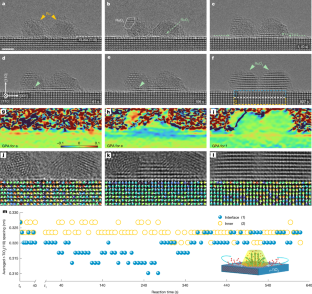
As one dynamic aspect of catalysis, spillover is known as species diffusion between an active metal and its support1,2,3, especially in reactions involving hydrogen and oxygen4,5,6,7,8. Spillover confined on the catalyst surface has been investigated extensively9,10; however, it remains unclear whether the bulk catalyst participates in the reactions through non-surface spillover. Here we track the oxygen spillover in Ru/TiO2 catalysts using in situ environmental transmission electron microscopy. Lattice oxygen was found to transport directly from the TiO2 substrate to the supported Ru particles through the Ru/TiO2 interface instead of the traditionally expected surface diffusion11. As a result, the TiO2 lattice at the subsurface was strained reversibly to provide channels for oxygen transport, as detected by the picometre-precision tracing of atomic displacement. The structural adaptability at the metal–support interface is critical for controlling oxygen spillover, which is switched on in Ru/rutile-TiO2 but switched off in Ru/anatase-TiO2. As shown by the real-time atom-resolved evidence, this bulk oxygen spillover is generally viable in supported metal catalysts of an interfacial epitaxy nature and demonstrates the significance of rationally engineered metal–support interfaces for activating the oxygen in bulk catalyst to contribute to reactions.