2026-04-15 米国国立標準技術研究所(NIST)
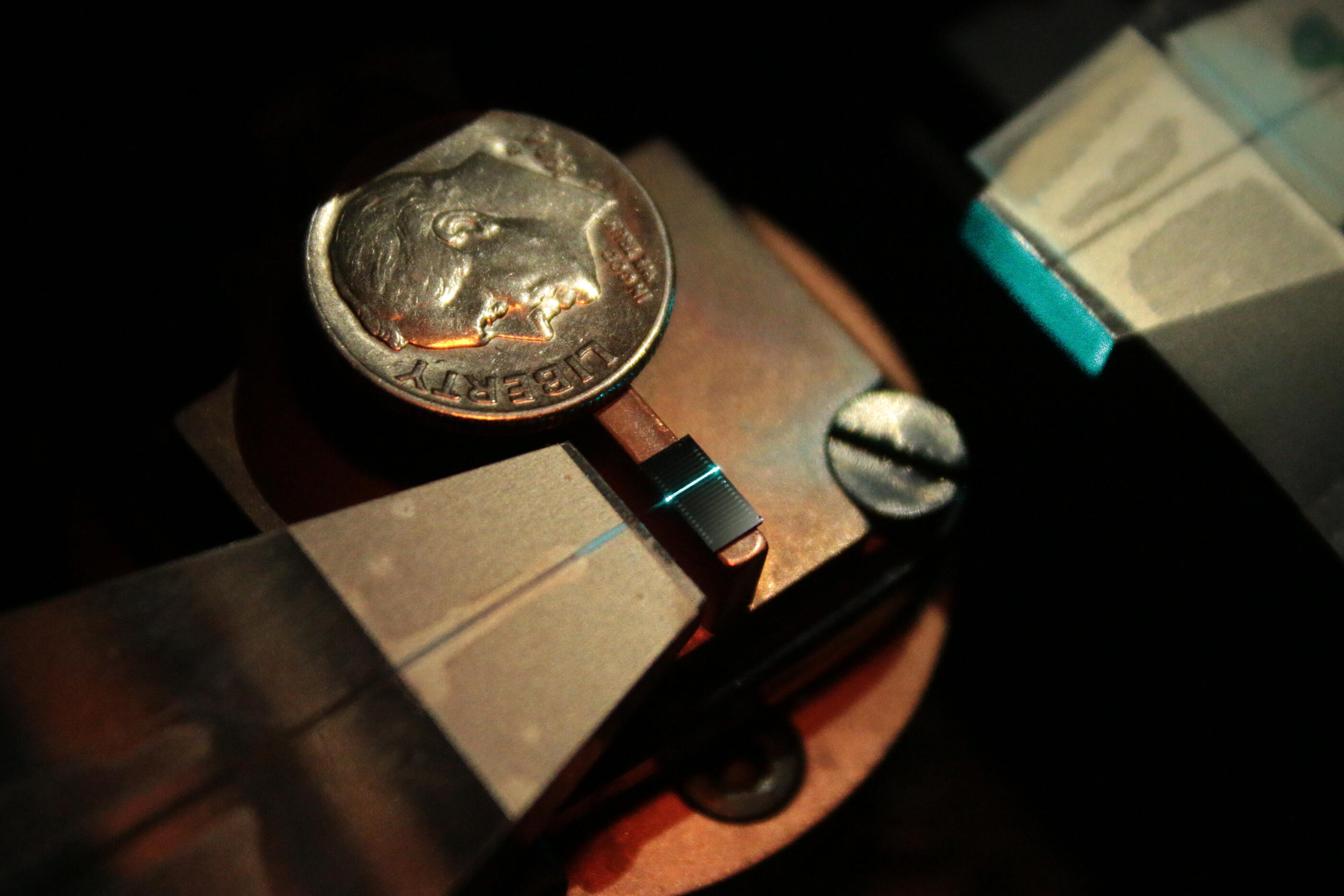
This small rectangular chip has been fabricated with numerous circuits designed to change the color of laser light. In the photo, one of these circuits is shown converting invisible infrared light into visible blue light. (A dime provides a size comparison.)Credit: R. Jacobson/NIST
<関連情報>
- https://www.nist.gov/news-events/news/2026/04/any-color-you-nist-scientists-create-any-wavelength-lasers-tiny-circuits
- https://www.nature.com/articles/s41586-026-10379-w
五酸化タンタル非線形フォトニクスのモノリシック3D集積 Monolithic 3D integration of tantalum pentoxide nonlinear photonics
Grant M. Brodnik,Grisha Spektor,Lindell M. Williams,Jizhao Zang,Alexa R. Carollo,Atasi Dan,Jennifer A. Black,David R. Carlson & Scott B. Papp
Nature Published:15 April 2026
DOI:https://doi.org/10.1038/s41586-026-10379-w
Abstract
The photonics landscape encompasses a wide scope of material platforms, each optimized for specific functionalities, yet no platform meets the demands of all current and evolving photonic applications. Although combining integrated-photonics materials enhances overall capability, such as unifying nonlinear optics, low-loss passive devices and electro-optics, material and process compatibility remains a major challenge. Here we introduce full-wafer, monolithic 3D integration of tantalum pentoxide (Ta2O5, hereafter tantala1) photonics directly onto a patterned substrate, demonstrated here with thin-film lithium niobate2. Tantala’s unique properties, importantly room-temperature deposition, moderate-temperature annealing and low residual stress in thick films optimized for phase matching, make it well suited for monolithic 3D integration without compromising substrate performance or compatibility. We demonstrate low-loss, high-quality-factor microresonators and nanophotonics in tantala, robust quasi-phase-matching in poled lithium niobate waveguides3, and efficient 3D interlayer routing. These capabilities enable us to demonstrate a rich palette of nonlinear frequency conversion processes, including χ(3) four-wave mixing for supercontinuum generation, optical parametric oscillation and dark-pulse microcomb generation in tantala microresonators and photonic crystal resonators, χ(2) second-harmonic generation in periodically poled lithium niobate, and combinations thereof.