2026-04-02 マサチューセッツ工科大学(MIT)
米マサチューセッツ工科大学の研究チームは、都市の交通による排出ガスを街区単位でリアルタイム測定する新手法を開発した。従来は広域平均に依存していたが、本研究では高解像度センサーとデータ解析を組み合わせ、道路ごとの排出量変動を詳細に把握可能とした。これにより、特定エリアや時間帯での汚染ピークを特定でき、より精密な環境対策や交通管理に活用できる。
この技術は都市の大気質管理や温室効果ガス削減政策の高度化に貢献し、スマートシティや持続可能な都市設計の基盤となることが期待される。
<関連情報>
- https://news.mit.edu/2026/mit-researchers-measure-traffic-emissions-block-real-time-0402
- https://www.nature.com/articles/s41893-026-01797-9
交通排出量推定と政策評価のためのユビキタスなデータ駆動型フレームワーク Ubiquitous data-driven framework for traffic emission estimation and policy evaluation
Songhua Hu,Paolo Santi,Tom Benson,Xuesong Zhou,An Wang,Ashutosh Kumar & Carlo Ratti
Nature Sustainability Published:02 April 2026
DOI:https://doi.org/10.1038/s41893-026-01797-9
Abstract
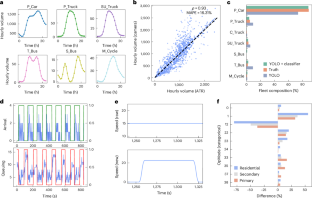
Quantifying urban traffic emission dynamics is critical for evaluating decarbonization policies, yet existing models often lack resolution, timeliness or scalability. Ubiquitous urban data offer new opportunities for large-scale, fine-grained and near-real-time emission estimation. Here we present a data-driven framework that integrates traffic camera footage with mobile phone data to estimate citywide vehicular emissions. Applied to Manhattan, New York, our method captures substantial spatiotemporal variation in emissions across hours, days and road segments. Omitting fine-grained inputs, such as traffic signals, speed variation or fleet heterogeneity, introduces average uncertainties of −49% to +25% in emission estimates. We further evaluate the early impacts of Manhattan’s congestion pricing programme, finding that 8 weeks after the implementation, traffic volumes declined by 10%, resulting in a 16–22% drop in emissions. Our approach enables timely, high-resolution policy assessment using widely available urban big data, offering a practical and transferable tool for supporting climate action.