2026-03-31 カリフォルニア大学リバーサイド校(UCR)
<関連情報>
- https://news.ucr.edu/articles/2026/03/31/cow-manure-digesters-really-cut-methane-unless-they-leak
- https://iopscience.iop.org/article/10.1088/1748-9326/ae4fe4
- https://onlinelibrary.wiley.com/doi/10.1111/gcbb.70047
遠隔探査によるカリフォルニア州の酪農場からの点源メタン排出量に対する嫌気性消化槽の影響評価 Evaluating the impact of anaerobic digesters on point source methane emissions from California dairies from remote sensing
Alyssa Valdez, Riley Duren, Daniel Cusworth, Nidia Rojas Robles, Diana Rodriguez Amezquita and Francesca M Hopkins
Environmental Research Letters Published: 24 March 2026
DOI:10.1088/1748-9326/ae4fe4
Abstract
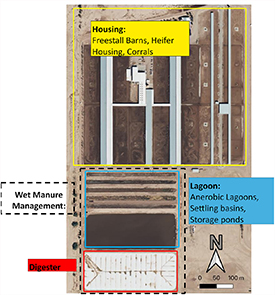
Dairies are the largest source of methane (CH4) emissions in California, with 57% of statewide emissions attributed to wet manure management systems. California has implemented CH4 mitigation strategies, including anaerobic digesters (ADs), to capture and convert CH4 produced by wet manure storage into renewable energy. While ADs are estimated to achieve large reductions in manure CH4 emissions, studies centered on their performance and the potential for fugitive emissions remain limited. Here, we analyze CH4 point source emissions at 98 California dairies from 2016 to 2024 using airborne imaging spectroscopy, covering pre-, during-, and post-digester installation periods. Emissions were attributed to housing, lagoons, digesters, and gas handling infrastructure. Overall emissions decreased significantly following installation from 91 ± 9–68 ± 9 kg CH4 h−1 (p = 0.001), with 68% of dairies exhibiting net reductions. However, digesters became the dominant emission source post-installation (47% of plumes), with some leaks exceeding 1000 kg CH4 h−1. Average emissions spiked during construction (197 ± 26 kg CH4 h−1), significantly exceeding both pre- and post-installation levels. Lagoon persistence as emission sources decreased substantially after installation (from 72% to 24% of plumes), yet they remained significant contributors with broad emission ranges (60–675 kg CH4 h−1). These findings demonstrate that remote sensing can successfully identify leaks from digesters and emphasizes the importance of frequent monitoring as a key strategy to improve digester efficiency. Comprehensive quantification of whole-farm emission reductions requires coordinated ground-based measurements and point source imaging.
嫌気性消化槽の設置により、カリフォルニア州の酪農場における液状糞尿管理に伴うメタン排出量が大幅に削減される Anaerobic Digester Installation Significantly Reduces Liquid Manure Management CH4 Emissions at a California Dairy Farm
Michael V. Rodriguez, Nidia Rojas Robles, Valerie Carranza, Ranga Thiruvenkatachari, Mariana Reyes, Chelsea V. Preble, Joyce Pexton, Deanne Meyer, Ray G. Anderson, Akula Venkatram, Francesca M. Hopkins
GCB Bioenergy Published: 04 June 2025
DOI:https://doi.org/10.1111/gcbb.70047
ABSTRACT
Anaerobic digesters are expected to significantly reduce CH4 emissions from dairy manure management by capturing them for use as biogas. Anaerobic digestion is the current major mitigation strategy for agricultural CH4 emissions in California’s climate policy. However, verification of the effectiveness of anaerobic digesters to reduce CH4 emissions has not been conducted at scale in California. We made atmospheric measurements from a mobile platform and used dispersion modeling to estimate CH4 emissions from a liquid manure storage complex at a typical California dairy before and after digester installation across nine field campaigns. The anaerobic digester reduced CH4 emissions by an average of 82% ± 16%, comparing paired months to predigester values. Prior to the digester, atmospheric CH4 mole fractions showed a persistent hotspot near the manure settling basin cells of 28.6 ± 8.9 ppm. After the digester, atmospheric CH4 mole fractions from manure storage were greatly reduced. We observed strong temporal variability across measurement campaigns due to weather, on-farm management practices, and digester operations. Estimated emissions greatly exceeded those based on inventory calculations used by the California Air Resources Board (CARB) but were in line with expected relative emissions reduction from digester installation. Scaling these results to 139 dairies with digester projects statewide suggests that similarly operating digesters would reduce CH4 emissions by 1.6 ± 0.3 MMT CO2e (65 ± 12 Gg CH4), 39% of the emissions reduction goal for livestock manure management set by California law. This work demonstrates the effectiveness of anaerobic digesters to reduce dairy manure management CH4 emissions in practice, along with the importance of understanding operations and management for interpreting on-farm CH4 emissions studies.