

2026-03-18 ノースウェスタン大学
<関連情報>
- https://news.northwestern.edu/stories/2026/03/spin-separates-giant-planets-from-failed-stars
- https://iopscience.iop.org/article/10.3847/1538-3881/ae434b
巨大惑星と褐色矮星の伴星の独特な自転進化 Distinct Rotational Evolution of Giant Planets and Brown Dwarf Companions
Chih-Chun Hsu, Jason J. Wang (王劲飞), Jerry W. Xuan, Yapeng Zhang, Jean-Baptiste Ruffio, Dimitri Mawet, Luke Finnerty, Katelyn Horstman, Julianne Cronin, Yinzi Xin,…
The Astronomical Journal Published: 2026 March 18
DOI:10.3847/1538-3881/ae434b
Abstract
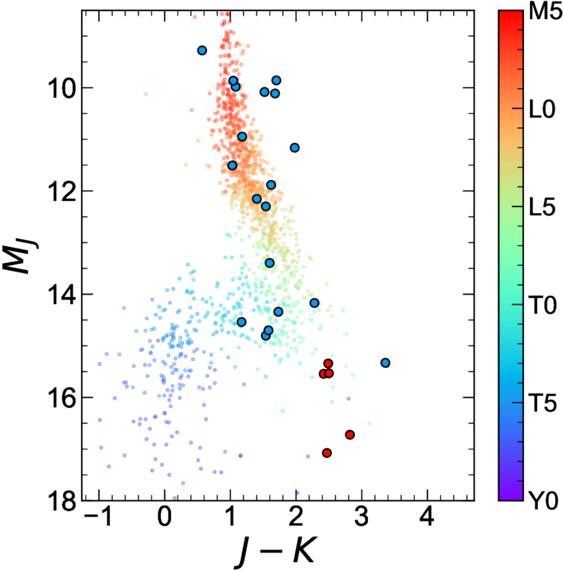
We present a rotational velocity () survey of 32 stellar/substellar objects and giant planets using Keck/KPIC high-resolution spectroscopy, including 6 giant planets (2–7 MJup) and 25 substellar/stellar companions (12–88 MJup). Adding companions with spin measurements from the literature, we construct a curated spin sample for 43 benchmark stellar/substellar companions and giant planets and 54 free-floating brown dwarfs and planetary mass objects. We compare their spins, parameterized as fractional breakup velocities at 10 Myr, assuming constant angular momentum evolution. We find the first clear evidence that giant planets exhibit distinct spins versus low-mass brown dwarf companions (10–40 MJup) at 4–4.5σ significance assuming inclinations aligned with their orbits, while under randomly oriented inclinations the significance is at 1.6–2.1σ. Our findings hold when considering various assumptions about planets, and the mass ratio below 0.8% gives a clean cut for rotation between giant planets and brown dwarf companions. The higher fractional breakup velocities of planets can be interpreted as less angular momentum loss through circumplanetary disk braking during the planet formation phase. Brown dwarf companions exhibit evidence of slower rotation compared to isolated brown dwarfs, while planets and planetary mass objects show similar spins. Finally, our analysis of specific angular momentum versus age of 221 stellar/substellar objects below 0.1 M⊙ with spin measurements in the literature indicates that the substellar objects of 5–40 MJup retain much higher angular momenta compared to stellar and substellar objects of 40–100 MJup after 10 Myr, when their initial angular momenta were set.

