2026-03-19 合肥物質科学研究院(HFIPS)
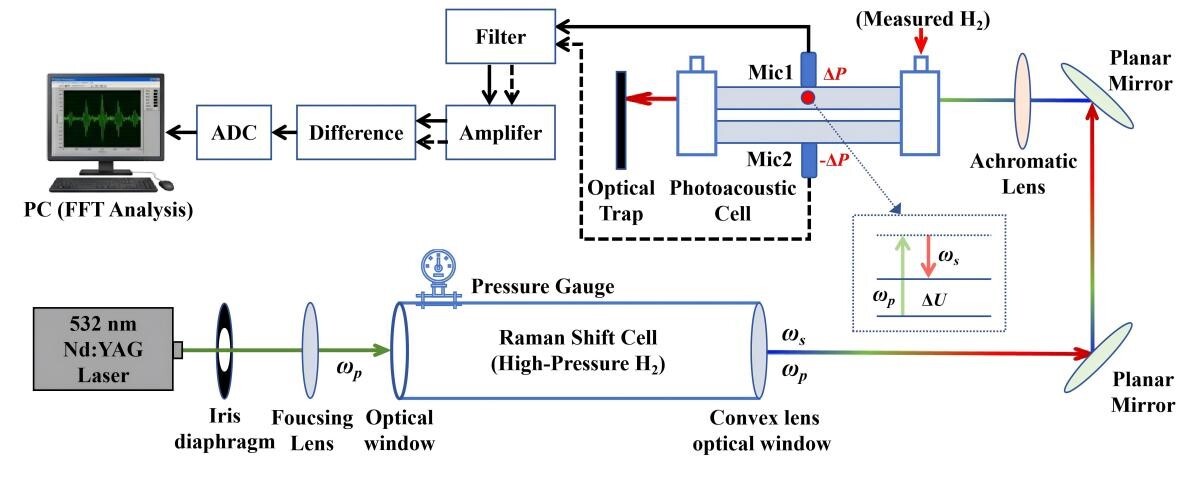
Schematic diagram of the DPA-SRS hydrogen detection system (Image by LI Zhengang)
<関連情報>
- https://english.hf.cas.cn/nr/bth/202603/t20260319_1152996.html
- https://www.sciencedirect.com/science/article/pii/S2213597926000200
高感度水素検出のための差分光音響刺激ラマン分光法(DPA-SRS) Differential photoacoustic-stimulated Raman spectroscopy (DPA-SRS) for high-sensitivity hydrogen detection
Xin Yu, Zhengang Li, Jiaxiang Liu, Haichun Xu, Junfang Miao, Canlong Wang, Yongqing Fang, Ying Pan, Yonghua Fang
Photoacoustics Available online: 25 February 2026
DOI:https://doi.org/10.1016/j.pacs.2026.100814
Abstract
To detect non-polar, infrared-inactive hydrogen, a Differential Photoacoustic-Stimulated Raman Spectroscopy (DPA-SRS) method is proposed. Utilizing the SRS process, a portion of the pump light is converted into intense Stokes light corresponding to the hydrogen Raman shift, eliminating complex dual-laser configurations. The nonlinear thermoacoustic effect is excited by this dual-color light field, endowing Photoacoustic Spectroscopy with the capability for hydrogen fingerprint identification. Raman cell pressure was optimized to achieve a synergistic enhancement of the Stokes conversion efficiency and the Four-Wave Mixing effect. Furthermore, an acoustic mode-optimized differential H-type resonant photoacoustic cell was designed, which effectively enhances anti-interference capability through the differential detection mechanism. Distinct from traditional lock-in amplification methods, a time-frequency transformation algorithm was employed to precisely extract the frequency-domain photoacoustic signal from the broadband time-domain acoustic signal. Experimental results demonstrate that the DPA-SRS system exhibits excellent linearity and achieves a Limit of Detection of 0.65 ppm under atmospheric conditions.