2026-03-18 東北大学
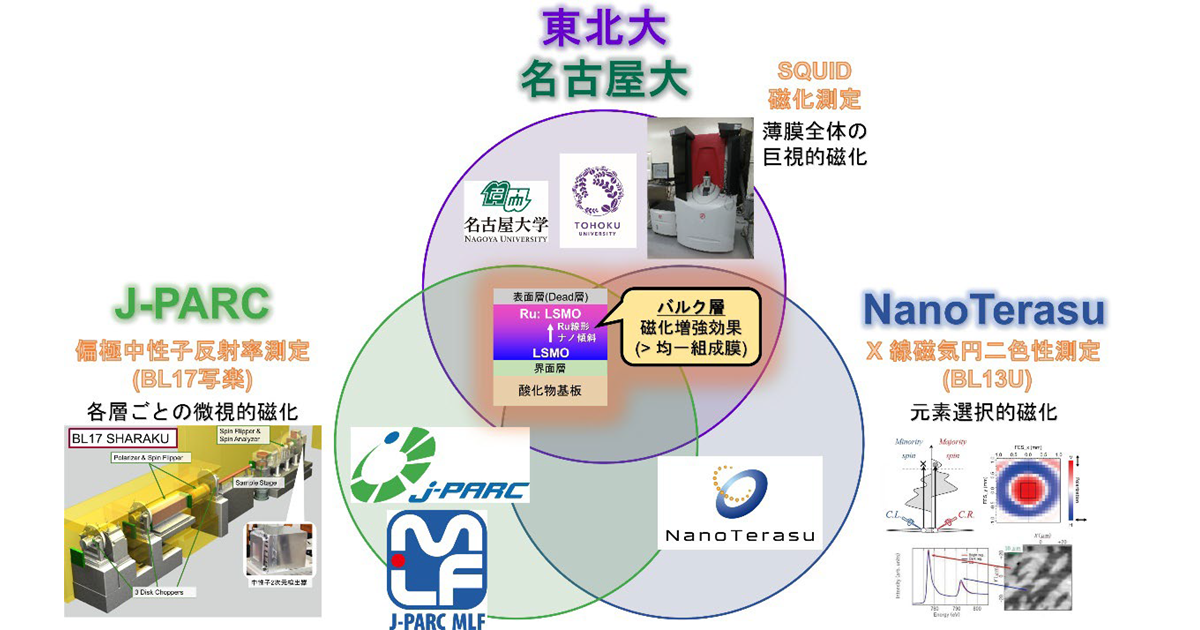
図. 国内の大型研究施設を連携活用し、相補的解析を行った。
<関連情報>
- https://www.tohoku.ac.jp/japanese/2026/03/press20260318-02-nano.html
- https://www.tohoku.ac.jp/japanese/newimg/pressimg/tohokuuniv-press2025318_02web_nano.pdf
- https://pubs.acs.org/doi/10.1021/acsaelm.6c00176
組成勾配を有するRu:LSMOエピタキシャル薄膜における保磁力と磁化のバランス:相補的アプローチによる表面/界面磁性とバルク磁性の個別解析 Balancing Both Coercivity and Magnetization in Compositionally Graded Ru:LSMO Epitaxial Thin Films: A Separate Analysis of Surface/Interface and Bulk Magnetism by a Complementary Approach
Gaku Sato,Kenichi Kaminaga,Takayasu Hanashima,Kazuhiro Akutsu-Suyama,Tetsuro Ueno,Yoshiyuki Ohtsubo,Yuto Abiko,Ryota Kimura,Keita Sasaki,Hibiki Murakami,Keisuke Haruki,Ayumu Kikuchi,Rintaro Kimura,Hiroshi Naganuma,Shingo Maruyama,Hiroyuki Aoki,and Yuji Matsumoto
ACS Applied Electronic Materials Published: March 12, 2026
DOI:https://doi.org/10.1021/acsaelm.6c00176
Abstract
Compositionally graded profiles of a substituent element artificially introduced into a complex oxide can offer a viable route to decouple and retune physical properties in a trade-off relationship caused by uniform substitution. Here, this is demonstrated with particular attention to the magnetism in Ru-substituted LSMO ((La,Sr)(Mn,Ru)O3) epitaxial films with the Ru composition linearly increasing (UP-graded) or decreasing (DOWN-graded) along the growth direction. A combination of macroscopic magnetometry and depth-resolved polarized neutron reflectometry (PNR) allows for the magnetism of surface/interface and the in-between bulk layer to be separately discussed to reveal how the introduction of a composition gradient has solved the trade-off among Curie temperature (TC), saturation magnetization (Ms), and coercivity (Hc) in Ru-substituted LSMO. Macroscopically graded films exhibit as much enhancement in Hc as the corresponding uniformly substituted films, with TC and Ms, which otherwise will be monotonically reduced, being maintained as high as the unsubstituted film. In an UP-graded film, the surface and interface magnetization is more strongly suppressed than that in the uniformly substituted films, while the Ms in the in-between bulk layer is found to be microscopically graded according to the local Ru composition. Importantly, despite the suppression in magnetization at the interface and surface, each local magnetization in the in-between bulk layer is higher than that of its uniform counterpart. As a result, the UP-graded LSMO yields higher magnetization than the corresponding uniformly substituted film, consistent with the macroscopic magnetometry result. Bulk-sensitive Mn L2,3-edge fluorescence-yield X-ray magnetic circular dichroism (XMCD) of the UP-graded film further provides evidence that the Mn spin sublattice is genuinely responsible for the magnetic enhancement by the Ru composition gradient. The present successful balancing of TC, Ms, and Hc in LSMO will reinforce the possibility of LSMO as a spintronic oxide material, encouraging further exploration of potential applications of the compositionally graded profiling approach in other related oxide systems.