2026-03-03 清華大学
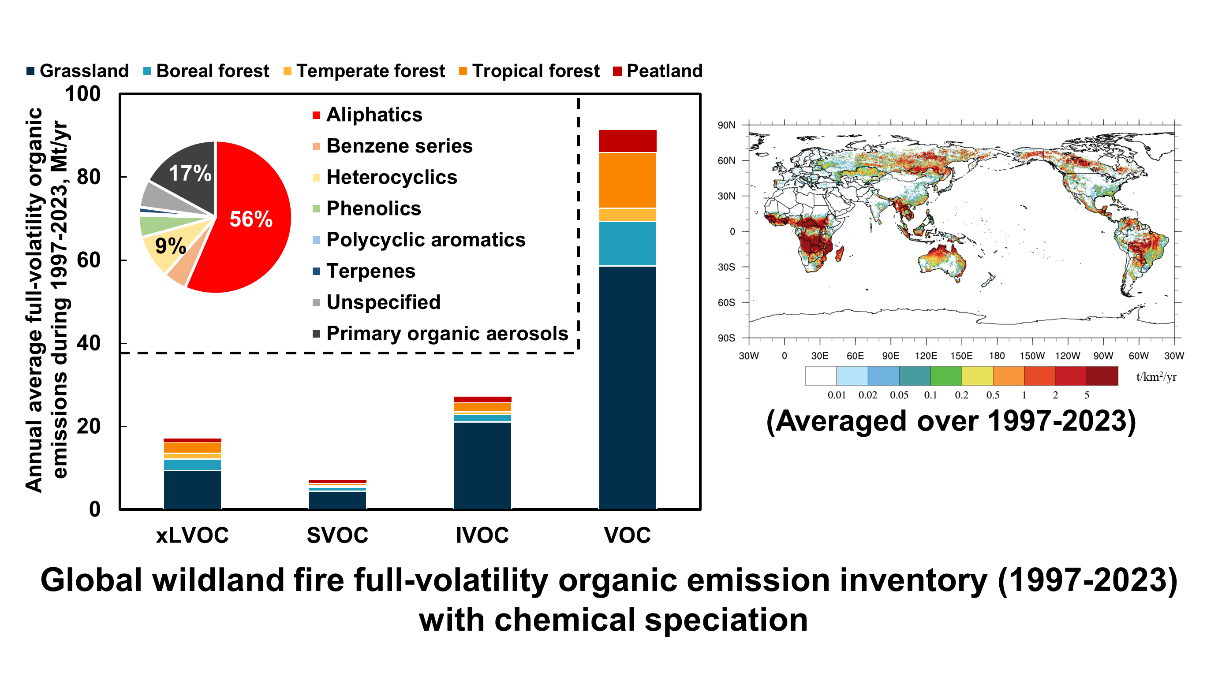
Figure 2. Global wildland fire full-volatility organic emission inventory (1997-2023) with chemical speciation
<関連情報>
- https://www.tsinghua.edu.cn/en/info/1245/14722.htm
- https://pubs.acs.org/doi/abs/10.1021/acs.est.5c10217
1997年から2023年までの世界の山火事による全揮発性有機化合物の排出量 Global Wildland Fire Emissions of Full-Volatility Organic Compounds from 1997 to 2023
Lyuyin Huang,Bin Zhao,Yicong He,Xing Chang,Mingchen Ma,Dejia Yin,Qingru Wu,Shuxiao and Wang
Environmental Science & Technology Published: December 29, 2025
DOI:https://doi.org/10.1021/acs.est.5c10217
Abstract
Wildland fires are significant sources of organic compounds, but traditional global fire emission inventories only include primary organic aerosols (POA) and volatile organic compounds (VOCs) and lack intermediate-volatility and semivolatile organic compounds (IVOCs and SVOCs), which could underestimate the environmental impact of wildland fires. We developed a global wildland fire organic emission inventory (1997–2023) with full-volatility coverage using volatility-binned and chemically specific emission factors by vegetation type. Compared to the traditional POA + VOC framework, full-volatility organic emission inventories filled a gap of 25.1 Mt/year of I/SVOCs; grassland, tropical forest, boreal forest, peatland, and temperate forest fires contributed 66%, 13%, 11%, 6%, and 4%, respectively, to full-volatility emissions (averaged over 1997–2023). Southern Hemisphere Africa was the top emission hotspot, with full-volatility organic emissions of 4.4 t/km2/year, 1.3–6.9 times greater than the next highest-emitting emission hotspots: Northern Hemisphere Africa, Southern Hemisphere South America, and Equatorial Asia. On a global scale, wildland fire organic emissions are 79% of anthropogenic organic emissions, but their I/SVOC emissions are comparable. With a more comprehensive consideration of the mass and chemical speciation of full-volatility organics, this emission inventory could enhance our understanding of the impact of wildland fires on air quality and human health.