2026-02-26 中国科学院(CAS)
<関連情報>
- https://english.cas.cn/newsroom/cas-in-media/202602/t20260226_1151215.shtml
- https://iopscience.iop.org/article/10.3847/1538-4357/ae2c7e
SpecCLIP: 星の分光測定のアラインメントと変換 SpecCLIP: Aligning and Translating Spectroscopic Measurements for Stars
Xiaosheng Zhao, Yang Huang, Guirong Xue, Xiao Kong, Jifeng Liu, Xiaoyu Tang, Timothy C. Beers, Yuan-Sen Ting, and A-Li Luo
The Astrophysical Journal Published: 2026 February 11
DOI:10.3847/1538-4357/ae2c7e
Abstract
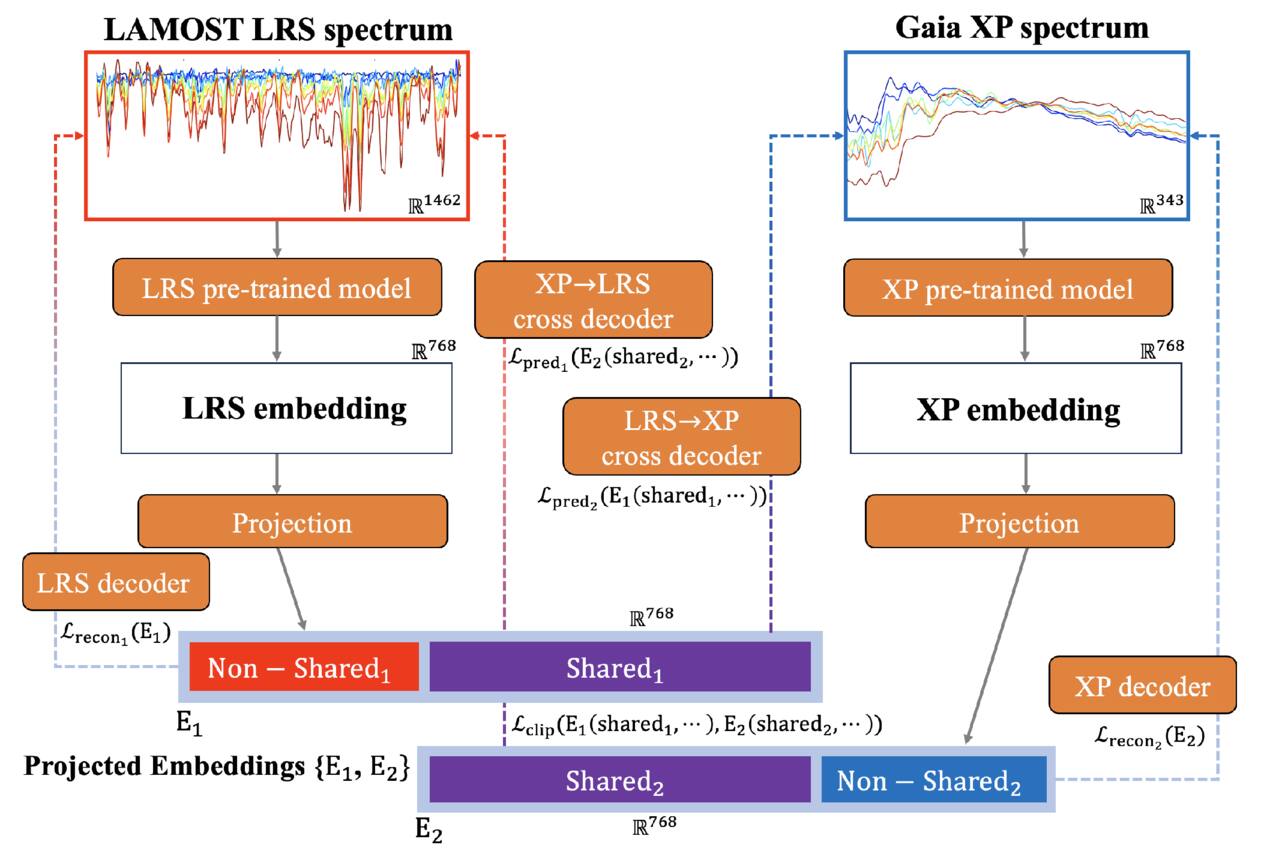
In recent years, large language models (LLMs) have transformed natural language understanding through vast data sets and large-scale parameterization. Inspired by this success, we present SpecCLIP, a foundation model framework that extends LLM-inspired methodologies to stellar spectral analysis. Stellar spectra, akin to structured language, encode rich physical and chemical information about stars. By training foundation models on large-scale spectral data sets, our goal is to learn robust and informative embeddings that support diverse downstream applications. As a proof of concept, SpecCLIP involves pretraining on two spectral types—LAMOST low-resolution and Gaia XP—followed by contrastive alignment using the Contrastive Language–Image Pretraining (CLIP) framework, adapted to associate spectra from different instruments. This alignment is complemented by auxiliary decoders that preserve spectrum-specific information and enable translation (prediction) between spectral types, the former being achieved by maximizing mutual information between embeddings and input spectra. The result is a cross-spectrum framework that enables intrinsic calibration and flexible applications across instruments. We demonstrate that fine-tuning these models on moderate-sized labeled data sets improves adaptability to tasks such as stellar-parameter estimation and chemical-abundance determination. SpecCLIP also enhances the accuracy and precision of parameter estimates benchmarked against external survey data. In addition, its similarity search and cross-spectrum prediction capabilities offer potential for anomaly detection. Our results suggest that contrastively trained foundation models enriched with spectrum-aware decoders can advance precision stellar spectroscopy. Our code SpecCLIP is publicly available on GitHub ✎.