
2026-01-23 英国研究イノベーション機構(UKRI)
<関連情報>
- https://www.ukri.org/news/scientists-release-most-detailed-analysis-on-expanding-universe/
- https://arxiv.org/abs/2601.14559
ダークエネルギーサーベイ6年目の成果:銀河団形成と弱い重力レンズ効果による宇宙論的制約
Dark Energy Survey Year 6 Results: Cosmological Constraints from Galaxy Clustering and Weak Lensing
DES Collaboration: T. M. C. Abbott, M. Adamow, M. Aguena, A. Alarcon, S. S. Allam, O. Alves, A. Amon, D. Anbajagane, F. Andrade-Oliveira, S. Avila, D. Bacon, E. J. Baxter, J. Beas-Gonzalez, K. Bechtol, M. R. Becker, G. M. Bernstein, E. Bertin, J. Blazek, S. Bocquet, D. Brooks, D. Brout, H. Camacho, G. Camacho-Ciurana, R. Camilleri, G. Campailla, A. Campos, A. Carnero Rosell, M. Carrasco Kind, J. Carretero, P. Carrilho, F. J. Castander, R. Cawthon, C. Chang, A. Choi, J. M. Coloma-Nadal, M. Costanzi, M. Crocce, W. d’Assignies, L. N. da Costa, M. E. da Silva Pereira, T. M. Davis, J. De Vicente, J. DeRose, H. T. Diehl, S. Dodelson, P. Doel, C. Doux, A. Drlica-Wagner, T. F. Eifler, J. Elvin-Poole, J. Estrada, S. Everett, A. E. Evrard, J. Fang, A. Farahi, A. Ferté, B. Flaugher, P. Fosalba, J. Frieman, J. García-Bellido, M. Gatti, E. Gaztanaga, G. Giannini, P. Giles, K. Glazebrook, M. Gorsuch, D. Gruen, R. A. Gruendl, J. Gschwend, G. Gutierrez, I. Harrison, W. G. Hartley, E. Henning, K. Herner, S. R. Hinton, D. L. Hollowood, K. Honscheid, E. M. Huff, D. Huterer, B. Jain, D. J. James, M. Jarvis, N. Jeffrey, T. Jeltema, T. Kacprzak, S. Kent, A. Kovacs, E. Krause, R. Kron, K. Kuehn, O. Lahav, S. Lee, E. Legnani, C. Lidman, H. Lin, N. MacCrann, M. Manera, T. Manning, J. L. Marshall et al. (72 additional authors not shown)
arXiv last revised 29 Jan 2026 (this version, v2)
DOI:https://doi.org/10.48550/arXiv.2601.14559
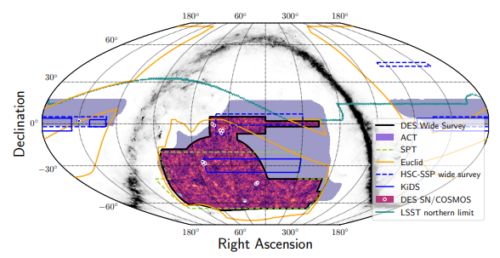
We present cosmology results combining galaxy clustering and weak gravitational lensing measured in the full six years (Y6) of observations by the Dark Energy Survey (DES) covering ∼5000 deg2 . We perform a largescale structure analysis with galaxy samples defined from the final data extending to redshift range z ≲ 2, using three two-point correlation functions (3×2pt): (i) cosmic shear measuring correlations among the shapes of 140 million source galaxies, (ii) auto-correlations of the spatial distribution of 9 million lens galaxies, and (iii) galaxy galaxy lensing from the cross-correlation between lens positions and source shapes. We perform the analysis under a rigorous blinding protocol to prevent confirmation biases. We model the data in flat ΛCDM and wCDM cosmologies. We find consistent cosmological results from subsets of the three two-point correlation functions. Their combined analysis yields S8 ≡ σ8(Ωm/0.3)0.5 = 0.789+0.012 −0.012 and matter density Ωm = 0.333+0.023 −0.028 in ΛCDM (68% CL), where σ8 is the clustering amplitude. The factor of two improvement in constraining power in the Ωm–σ8 plane relative to DES Year 3 is due to higher source number density, extended redshift range, and improved modeling. These constraints show a (full-space) parameter difference of 1.8σ from a combination of cosmic microwave background (CMB) primary anisotropy datasets from Planck 2018, ACT-DR6, and SPT-3G DR1. Projected only into S8 the difference is 2.6σ. In wCDM the Y6 3×2pt results yield S8 = 0.782+0.021 −0.020, Ωm = 0.325+0.032 −0.035, and dark energy equation-of-state parameter w = −1.12+0.26 −0.20. For the first time, we combine all DES dark-energy probes: 3×2pt, SNe Ia, BAO and Clusters. In ΛCDM this combination yields a 2.8σ parameter difference from the CMB. When combining DES 3×2pt with other most constraining lowredshift datasets (DESI DR2 BAO, DES SNe Ia, SPT clusters), we find a 2.3σ parameter difference with CMB. A joint fit of Y6 3×2pt, CMB, and those low-z datasets produces the tightest ΛCDM constraints to date: S8 = 0.806+0.006 −0.007, Ωm = 0.302+0.003 −0.003, h = 0.683+0.003 −0.002, and Σmν < 0.14 eV (95% CL). In wCDM, this dataset combination yields w = −0.981+0.021 −0.022, with no significant preference over ΛCDM.

