

2025-12-12 北海道大学
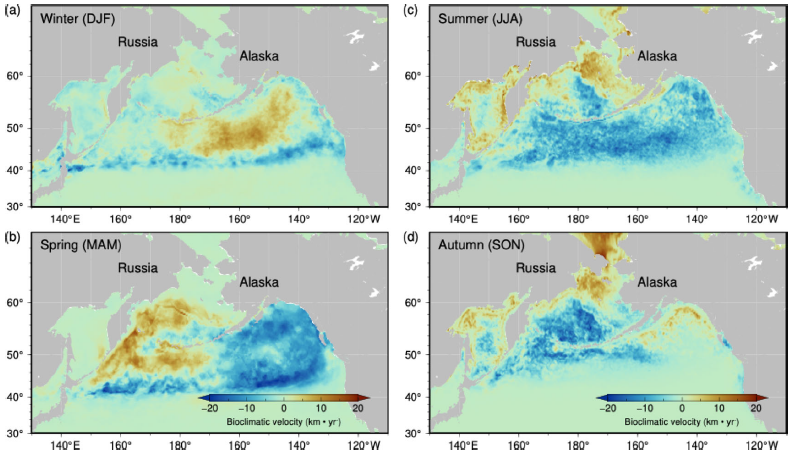
1998年から2022年までの越冬期におけるサケの季節生息海域の変化の空間分布。
(a)冬季(12月-2月)、(b)春季(3月-5月)、(c)夏季(6月-8月)、(d)秋季(9月-11月)
<関連情報>
- https://www.hokudai.ac.jp/news/2025/12/irene-d-alabia.html
- https://www.hokudai.ac.jp/news/pdf/251212_pr.pdf
- https://www.nature.com/articles/s41598-025-26397-z
Climate-driven shifts in marine habitat explain recent declines of Japanese Chum salmon 気候変動によるサケ生息海域の変化が日本産サケの減少を説明する
Irene D. Alabia,Sei-Ichi Saitoh,Jorge García Molinos,Takafumi Hirata,Yasuyuki Miyakoshi,Fumihiro Takahashi,Hiromichi Ueno & Masahide Kaeriyama
Scientific Reports Published:03 December 2025
DOI:https://doi.org/10.1038/s41598-025-26397-z
Abstract
Climate change is accelerating at unprecedented rates, with disproportionate impacts on marine ecosystems. We examined the distributional responses of chum salmon (Oncorhynchus keta), a keystone species, to the recent climatic changes in the North Pacific from 1998 to 2022. We applied a multi-model ensemble approach to examine the spatial and temporal distribution patterns of suitable habitats throughout their seasonal migratory grounds and relate them to recent declines of Japanese chum salmon stocks. Our modelling identified temporal shifts in the locations of feeding and overwintering grounds, driven by increasing ocean temperatures, deteriorating forage conditions, and strengthening wind and marine heatwave intensity. During their feeding migration, the suitable chum habitat in the Bering Sea was reduced but increased in the Arctic. Overwintering habitat patterns further captured an overall decline in the trailing edges of their distribution, accompanied by habitat shifts towards the central North Pacific. Periods of marine heatwaves further coincided with sizable habitat losses. Such habitat displacements potentially affect the Japanese chum salmon stocks, shown by substantial habitat reductions in the Okhotsk and central Bering seas. These findings highlight the exacerbating exposure and vulnerability of the chum salmon populations to recent climatic and productivity changes throughout their marine life history, with concomitant repercussions on their production dynamics and provision of ecosystem services. Thus, requiring climate-adaptive measures such as the readjustment of fishing seasons and quotas according to the changing salmon stocks and habitat conditions, and the improvement of current hatcheries practices to manage and conserve salmon resources.
