2025-11-10 ウィスコンシン大学マディソン校
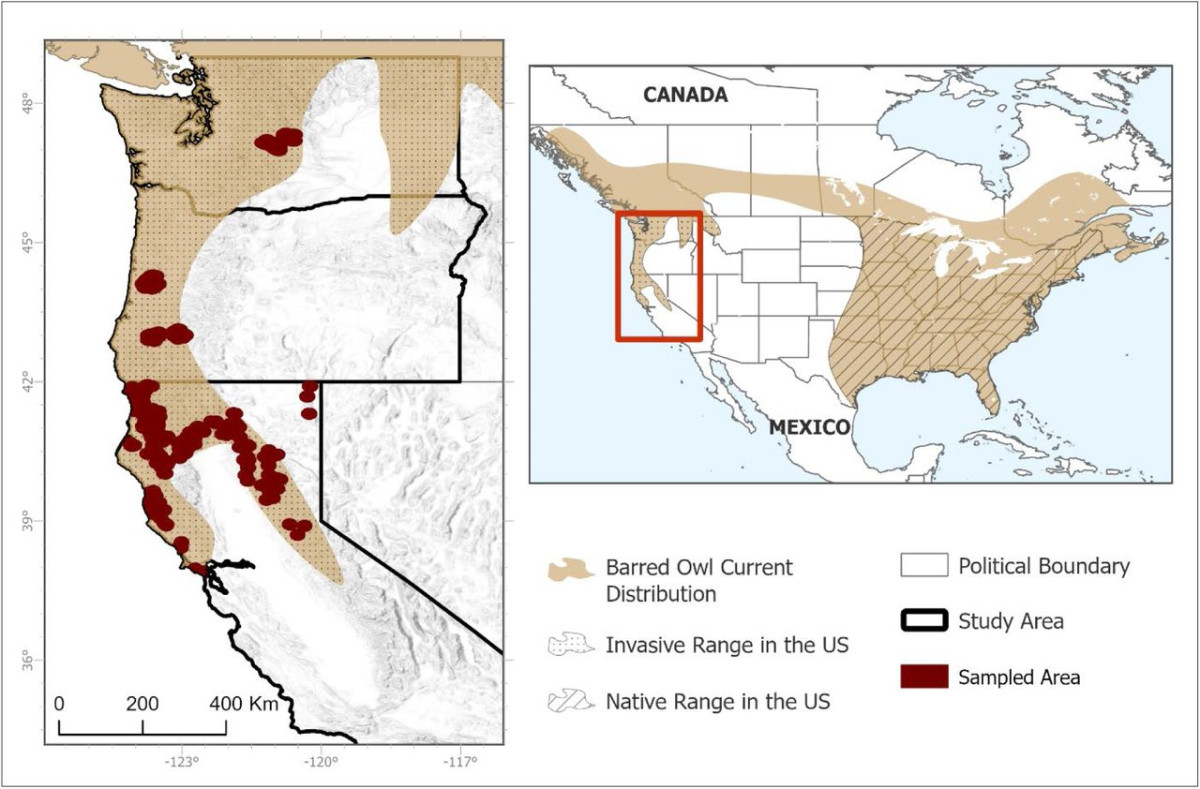
Barred owls spread west across Canada with help from people. UW–Madison researchers have collected animals in three invaded states on the West Coast to document their diets. Graphic by Peery Lab
<関連情報>
- https://news.wisc.edu/the-barred-owls-westward-migration-threatens-other-species-and-a-whole-ecosystem-uw-researchers-find/
- https://www.biorxiv.org/content/10.1101/2025.10.31.685899v1
フクロウ対フクロウの過去を考える:アメリカ西部の生態系を脅かすアメリカフクロウの侵略 Thinking past owl vs owl: The barred owl invasion threatens ecological communities in the western United States
Daniela Arenas-Viveros, Emma Fehlker Campbell, Amy L. Munes, Hollis Howe, Hermary M. Gonzales, J. Mark Higley, Daniel F. Hofstadter, Brendan K. Hobart, Greta M. Wengert, Angela Rex, Brian P. Dotters, Kevin N. Roberts, Christina P. Varian, M. Zachariah Peery, Emily D. Fountain
bioRxiv Posted: November 03, 2025.
DOI:https://doi.org/10.1101/2025.10.31.685899
ABSTRACT
Anthropogenic land use and climate change are facilitating intracontinental species range expansions, leading to novel ecological communities and interactions. Although invasive range-expanders threaten native species, lethal management can be challenged based on the notion that range-expanders are native and therefore less likely to precipitate ecological damage. The anthropogenically-mediated range expansion of barred owls (Strix varia) from eastern to western North America exemplifies this controversy: a recent U.S. Fish and Wildlife Service plan to cull barred owls for the benefit of spotted owls (Strix occidentalis) ignited public outcry and resistance. Here, we assessed barred owls’ potential invasiveness and broader effects on biodiversity by using molecular methods to characterize the diet of 788 individuals in California, Oregon, and Washington. Barred owls consumed 162 vertebrate and invertebrate prey species, including 29 species with federal- or state-level conservation status. Our findings suggest that barred owls may (1) threaten smaller native predators via intraguild predation and competition for shared prey; and (2) further imperil amphibian communities already threatened by a suite of environmental stressors. We thus contend that barred owls function as an invasive species in their expanded range. The Precautionary Principle suggests that large-scale lethal management is warranted to curb barred owls’ impacts on not just spotted owls but broader ecological communities in the forests of the Pacific Northwest. More broadly, our study highlights the significant biodiversity loss that could result from range expansions of a generalist predator and provides a roadmap for quantifying putative impacts.