2025-10-28 東京科学大学
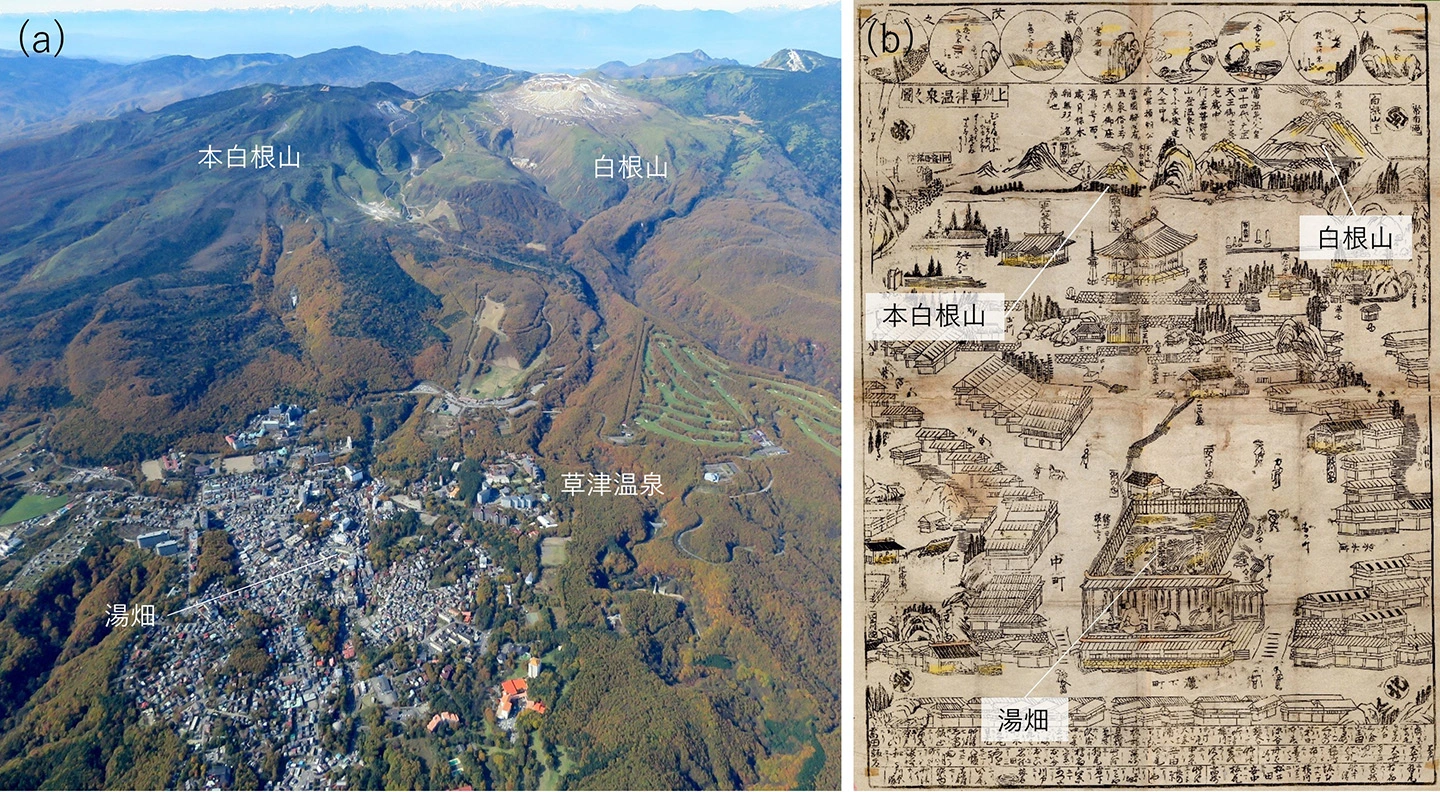
図1. (a)草津白根山。2021年撮影。(b)鳥瞰図の例(文政年間1818-1930年、群馬県立図書館所蔵)。(Terada and Sekido (2025) を加筆・修正して作成)
<関連情報>
- https://www.isct.ac.jp/ja/news/c606jzclub6j
- https://link.springer.com/article/10.1007/s00445-025-01890-5
草津温泉街の歴史的図面を用いて、草津白根山の過去の噴煙活動を再現する Reconstructing past volcanic plume activity of Kusatsu–Shirane volcano, Japan, using historical drawings of the Kusatsu spa area
Akihiko Terada & Akiko Sekido
Bulletin of Volcanology Published:24 October 2025
DOI:https://doi.org/10.1007/s00445-025-01890-5
Abstract
Kusatsu–Shirane volcano is one of the most active volcanoes in Japan; however, knowledge of the historical activity of its summit cones is limited, because a major fire in 1869 in the Kusatsu spa area at the foot of the volcano destroyed many historical documents. Until this study, historical eruptions at Mt. Motoshirane, one of pyroclastic cones, had not been documented, and the cone remained unmonitored prior to the 2018 eruption. In this study, we focus on historical bird’s-eye views (BEVs), which exhibit characteristics of both drawings and maps. Numerous BEVs of the Kusatsu spa area have been preserved, because they were frequently published and widely circulated as souvenirs from the nineteenth to the early twentieth centuries. Based on analyses of 69 BEVs, along with five historical notes and two pictorial maps and a sketch from the eighteenth century onward, a plume activity at Mt. Motoshirane has been identified in one of the BEVs for the first time. This indicates that either a transient, vigorous fumarolic activity or a single eruptive event occurred at Motoshirane cone during 1818–1830. We demonstrate that volcanic plume activity of Mt. Shirane, one of the pyroclastic cones, has persisted over the past 200 years, with the exception of a quiescent period during 1849–1881 AD. Since 1941, thermal activity has changed from persistent plume emissions to a hot crater lake. Numerous BEVs which were frequently published are useful tool for reconstructing past thermal activity, such as small phreatic eruptions, fumaroles, and hot crater lakes.