2025-09-29 生理学研究所
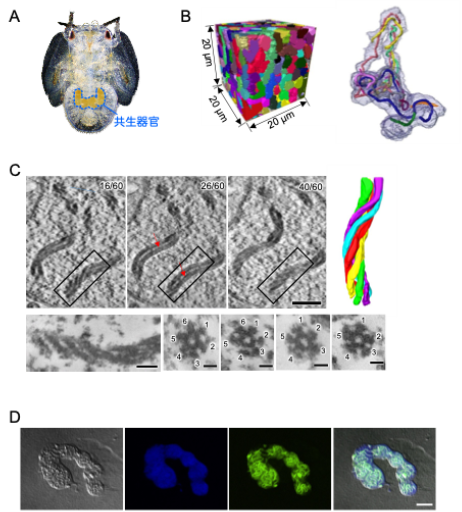
図A: ミカンキジラミ幼虫。体内が透けて見える処理をしてあり、破線部分が共生器官。
図B: SBF-SEMで得られたプロフテラ細胞と内部のチューブ構造の三次元像。
(左) 共生器官内で密に詰め込まれたプロフテラ。異なる色は異なる細胞を示す。
(右) 左図のブロック中に含まれる一つのプロフテラ細胞に注目したもので、内部の異なる色は異なるチューブを示す。
図C: チューブの微細構造を示すHVEMトモグラフィー像等。5~6本の繊維が右巻きにねじれたらせん状構造を取ることがわかる。
図D: 左から、プロフテラの微分干渉像、DNA染色像、FISH像、重ね合わせ像。FISH像はプロフテラのリボソームを検出しており、微分干渉像で見えるチューブと分布が一致することがわかる。
<関連情報>
- https://www.nips.ac.jp/release/2025/09/post_562.html
- https://www.nature.com/articles/s44303-025-00107-w
アジア産ミカンキジラミDiaphorina citriの防御共生細菌における謎めいた管状超微細構造 Enigmatic tubular ultrastructure in the bacterial defensive symbiont of the Asian citrus psyllid Diaphorina citri
Chihong Song,Junnosuke Maruyama,Kazuyoshi Murata,Toshinobu Suzaki & Atsushi Nakabachi
npj Imaging Published:18 September 2025
DOI:https://doi.org/10.1038/s44303-025-00107-w
Abstract
Candidatus Profftella armatura (Betaproteobacteria) is an organelle-like defensive symbiont inhabiting the symbiotic organ of a devastating citrus pest, the Asian citrus psyllid Diaphorina citri. Previous two-dimensional electron microscopy hinted at unprecedented ultrastructures in Profftella, but their precise architecture and composition were unknown. Here, using serial block-face scanning electron microscopy, high-voltage electron tomography, and fluorescence in situ hybridization, we show that elongated Profftella cells (2.8–136 μm observed) contain multiple tubes (1–43 per cell) up to 45 μm long. These tubes, occupying ~6.3% of the cell volume, are composed of five or six fibers twisted into a right-handed helix with a consistent diameter of ~230 nm. Their stability under high vacuum suggests a mechanical support role in elongated Profftella. Close association with ribosomes implies a possible role in protein synthesis. Our findings provide insight into the structural adaptations of intracellular symbionts and may inform strategies for controlling citrus pests.