

2025-09-12 筑波大学
<関連情報>
- https://www.tsukuba.ac.jp/journal/biology-environment/20250912180000.html
- https://www.tsukuba.ac.jp/journal/pdf/p20250912180000.pdf
- https://www.nature.com/articles/s41598-025-17929-8
4-CPAまたはエタノールの適用は、熱ストレス下におけるphyA変異体の植物成長と果実品質を向上させる Application of 4-CPA or ethanol enhances plant growth and fruit quality of phyA mutant under heat stress
Riham A. H. Ahmed,Islam M. Y. Abdellatif,Natsumi Oka,Misaki Kobayashi,Martina Bianca Fuhrmann-Aoyagi,Daisuke Todaka,Motoaki Seki & Kenji Miura
Scientific Reports Published:12 September 2025
DOI:https://doi.org/10.1038/s41598-025-17929-8
Abstract
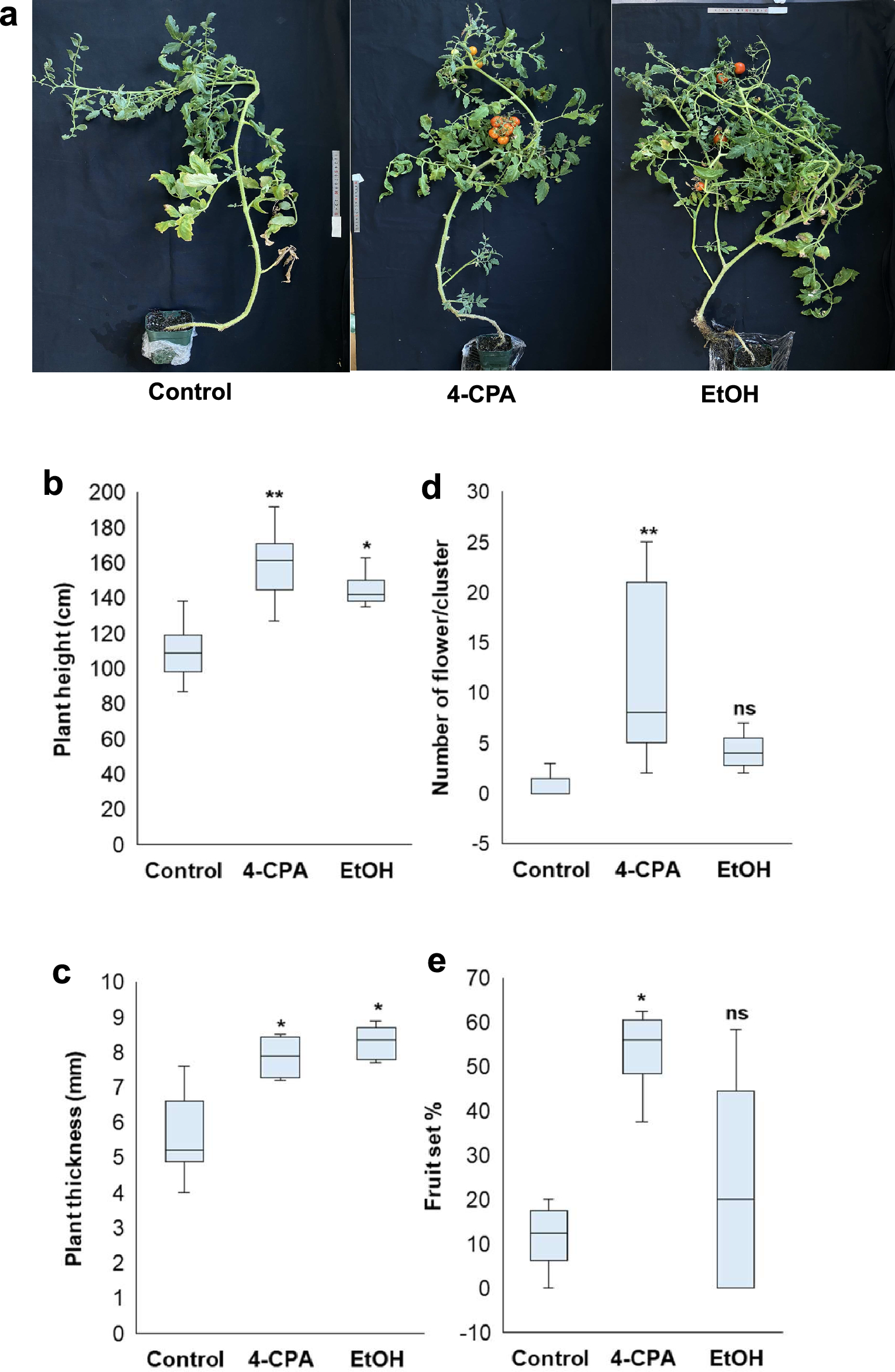
As the phytochromes play a key role in plant light perception, they also modulate stress responses. The tomato mutant c.v. Moneymaker lacking PHYTOCHROME A (PHYA) exhibits tolerance to heat stress during the vegetative growth phase; however, this response does not continue into the reproductive stage. In this study, the response of phyA at the reproductive stage was improved through the exogenous application of 4-chlorophenoxy acetic acid (4-CPA) and ethanol under heat stress, either at 37 °C in controlled culture room or fluctuating high temperatures (approximately 50 °C and 30 °C in midday and night, respectively) during the summer in greenhouse. 4-CPA, a synthesized plant growth regulator with functions similar to that of auxins, induced growth and flower formation at the flowering stage when sprayed on phyA compared to that in the non-treated plants. Similarly, 4-CPA application improved fruit setting and fruit characteristics, and the quantity or quality of the phyA mutant. The expression of numerous heat-related genes, such as heat shock factors (HSFs), heat shock proteins (HSPs), and reactive oxygen species (ROS) scavengers, was upregulated in phyA as a result of 4-CPA application. Ethanol application showed better growth when sprayed on phyA than non-treated plants, and HSFA1a and HSP70 expression was significantly stimulated by this treatment. On the other hand, applying either 4-CPA or ethanol-induced auxin and gibberellin production by stimulating the expression of genes involved in hormone production. Finally, electrolyte leakage (EL) and malondialdehyde (MDA) levels were inhibited after both treatments. In contrast, proline production increased. Therefore, applying 4-CPA or ethanol improved phyA mutant tolerance, allowing the mutant to tolerate heat stress during all growth stages. Furthermore, the quality of tomato fruits is improved by the application of these chemicals.

