2025-09-11 物質・材料研究機構
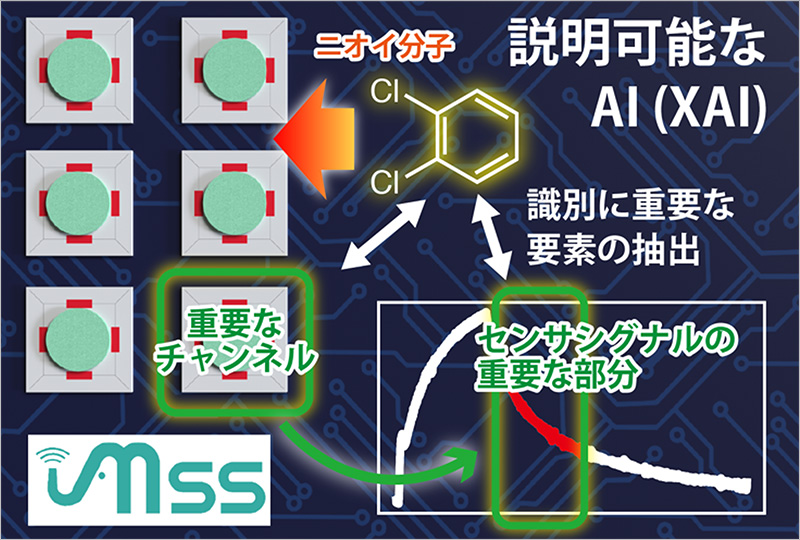
図: XAIによる嗅覚センサのニオイ識別過程の可視化。
ニオイ分子に応じて、どの感応材料が必要で、センサシグナルのどこが識別に重要かを抽出できます。
<関連情報>
説明可能なAIを活用した人工嗅覚における構造活性相関の探索 Harnessing Explainable AI to Explore Structure–Activity Relationships in Artificial Olfaction
Yota Fukui,Kosuke Minami,Genki Yoshikawa,Koji Tsuda,Ryo Tamura
ACS Applied Materials & Interfaces Published: September 8, 2025
DOI:https://doi.org/10.1021/acsami.5c13990
Abstract
Chemical sensor arrays mimic the mammalian olfactory system to achieve artificial olfaction, and receptor materials resembling olfactory receptors are being actively developed. To realize practical artificial olfaction, it is essential to provide guidelines for developing effective receptor materials based on the structure–activity relationship. In this study, we demonstrated the visualization of the relationship between sensing signal features and odorant molecular features using an explainable AI (XAI) technique. We focused on classification tasks and employed a convolutional neural network (CNN) and score-class activation mapping (Score-CAM) methods. The results obtained from analyzing the 94 odor samples prepared using pure solvents indicate that the information regarding the active receptor materials and data points in the signals and the structure–activity relationship could be accurately extracted. Therefore, using XAI techniques to analyze sensor signals from odor data is an important technique for advancing artificial olfaction.