2025-09-04 自然科学研究機構
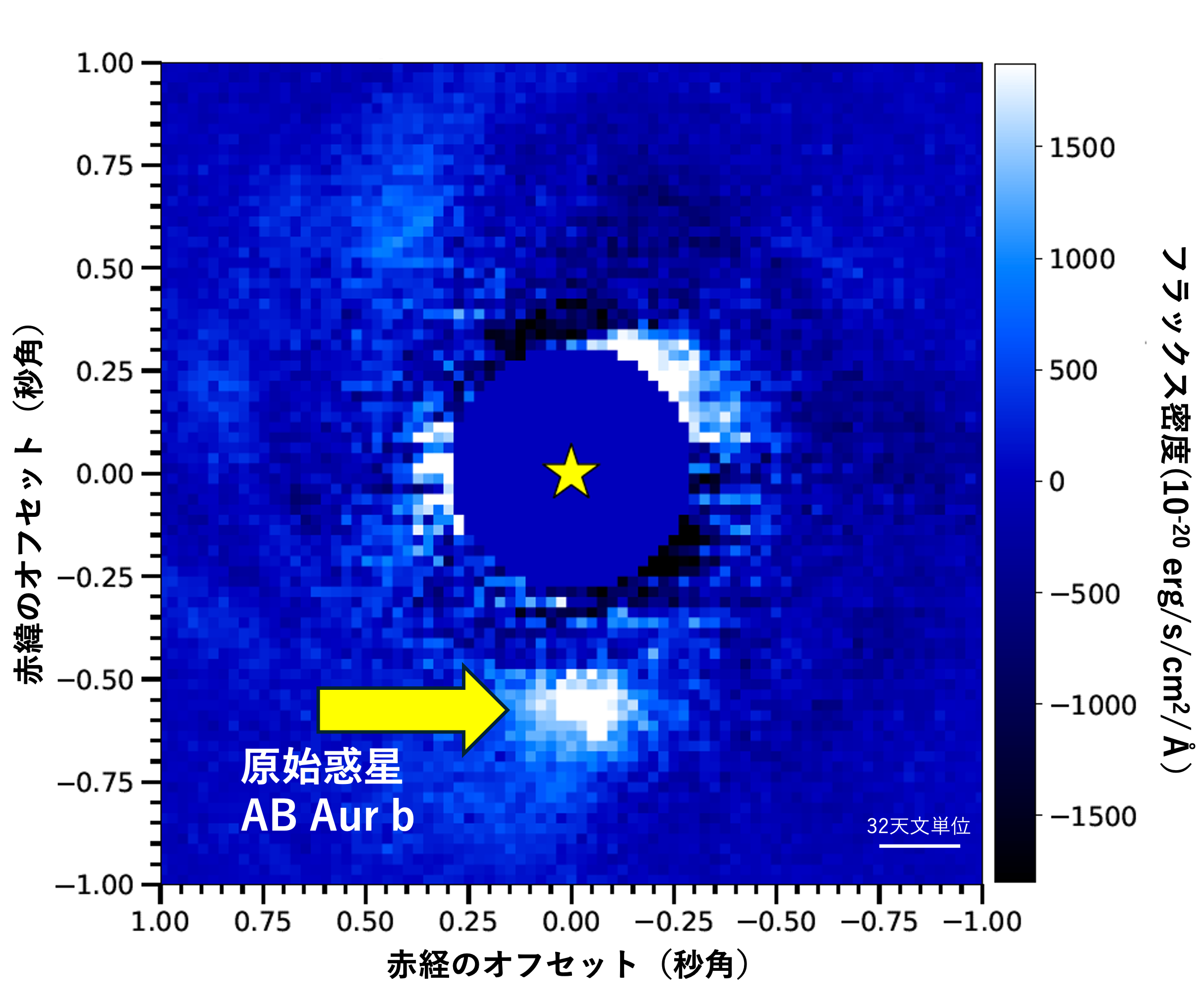
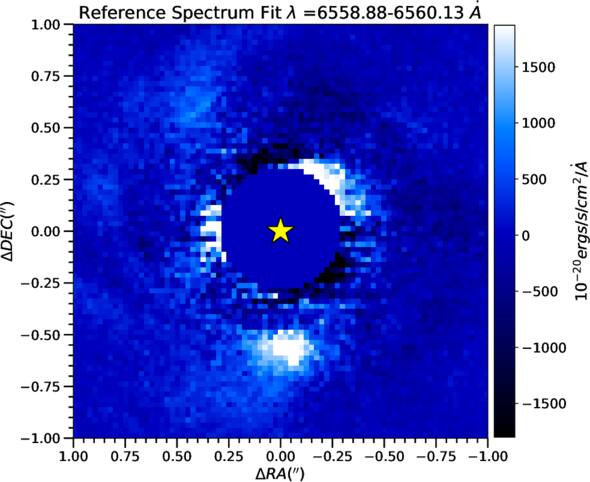
図1:ぎょしゃ座AB星の水素原子輝線(Hα線)の画像。原始惑星ぎょしゃ座AB星 bが、中心星からほぼ南方向に約0.6秒角離れた位置で明確に検出された。星印の0.3秒角以内の領域はマスクされている。(クレジット:T. Currie, アストロバイオロジーセンター)
<関連情報>
- https://www.abc-nins.jp/生まれたばかりの原始惑星への物質落ち込みの証/
- https://iopscience.iop.org/article/10.3847/2041-8213/adf7a0
- https://www.nature.com/articles/s41550-022-01634-x
VLT/MUSEによるHα分光観測:ぎょしゃ座α星b原始惑星の検出 VLT/MUSE Detection of the AB Aurigae b Protoplanet with Hα Spectroscopy
Thayne Currie, Jun Hashimoto, Yuhiko Aoyama, Ruobing Dong, Misato Fukagawa, Takayuki Muto, Erica Dykes, Mona El Morsy, and Motohide Tamura
The Astrophysical Journal Letters Published: 2025 September 2
DOI:10.3847/2041-8213/adf7a0
Abstract
We analyze high-contrast, medium-spectral-resolution Hα observations of the star AB Aurigae using the Very Large Telescope’s Multi Unit Spectroscopic Explorer (MUSE). In multiple epochs, MUSE detects the AB Aur b protoplanet discovered from Subaru/SCExAO data in emission at wavelengths slightly blueshifted from the Hα line center (i.e., at 6558.88–6560.13Å; ∼−100 km s−1) and in absorption at redshifted wavelengths (6562.8–6565.1Å; ∼75 km s−1). AB Aur b’s Hα spectrum is inconsistent with that of the host star or the average residual disk spectrum and is dissimilar to that of PDS 70 b and c. Instead, the spectrum’s shape resembles that of an inverse P Cygni profile seen in some accreting T Tauri stars and interpreted as evidence of infalling cold gas from accretion, although we cannot formally rule out all other nonaccretion origins for AB Aur b’s MUSE detection. AB Aurigae hosts only the second protoplanetary system detected in Hα thus far and the first with a source showing a spectrum resembling an inverse P Cygni profile. Future modeling and new optical data will be needed to assess how much AB Aur b’s emission source(s) originates from protoplanet accretion reprocessed by the disk, a localized scattered-light feature with a unique Hα profile, or another mechanism.
AB Aurigae周辺広域領域に存在する木星型惑星形成領域の画像 Images of embedded Jovian planet formation at a wide separation around AB Aurigae
Thayne Currie,Kellen Lawson,Glenn Schneider,Wladimir Lyra,John Wisniewski,Carol Grady,Olivier Guyon,Motohide Tamura,Takayuki Kotani,Hajime Kawahara,Timothy Brandt,Taichi Uyama,Takayuki Muto,Ruobing Dong,Tomoyuki Kudo,Jun Hashimoto,Misato Fukagawa,Kevin Wagner,Julien Lozi,Jeffrey Chilcote,Taylor Tobin,Tyler Groff,Kimberly Ward-Duong,William Januszewski,… Nour Skaf
Nature Astronomy Published:04 April 2022
DOI:https://doi.org/10.1038/s41550-022-01634-x
Abstract
Direct images of protoplanets embedded in disks around infant stars provide the key to understanding the formation of gas giant planets such as Jupiter. Using the Subaru Telescope and the Hubble Space Telescope, we find evidence for a Jovian protoplanet around AB Aurigae orbiting at a wide projected separation (~93 au), probably responsible for multiple planet-induced features in the disk. Its emission is reproducible as reprocessed radiation from an embedded protoplanet. We also identify two structures located at 430–580 au that are candidate sites of planet formation. These data reveal planet formation in the embedded phase and a protoplanet discovery at wide, >50 au separations characteristic of most imaged exoplanets. With at least one clump-like protoplanet and multiple spiral arms, the AB Aur system may also provide the evidence for a long-considered alternative to the canonical model for Jupiter’s formation, namely disk (gravitational) instability.