2025-09-09 東京科学大学
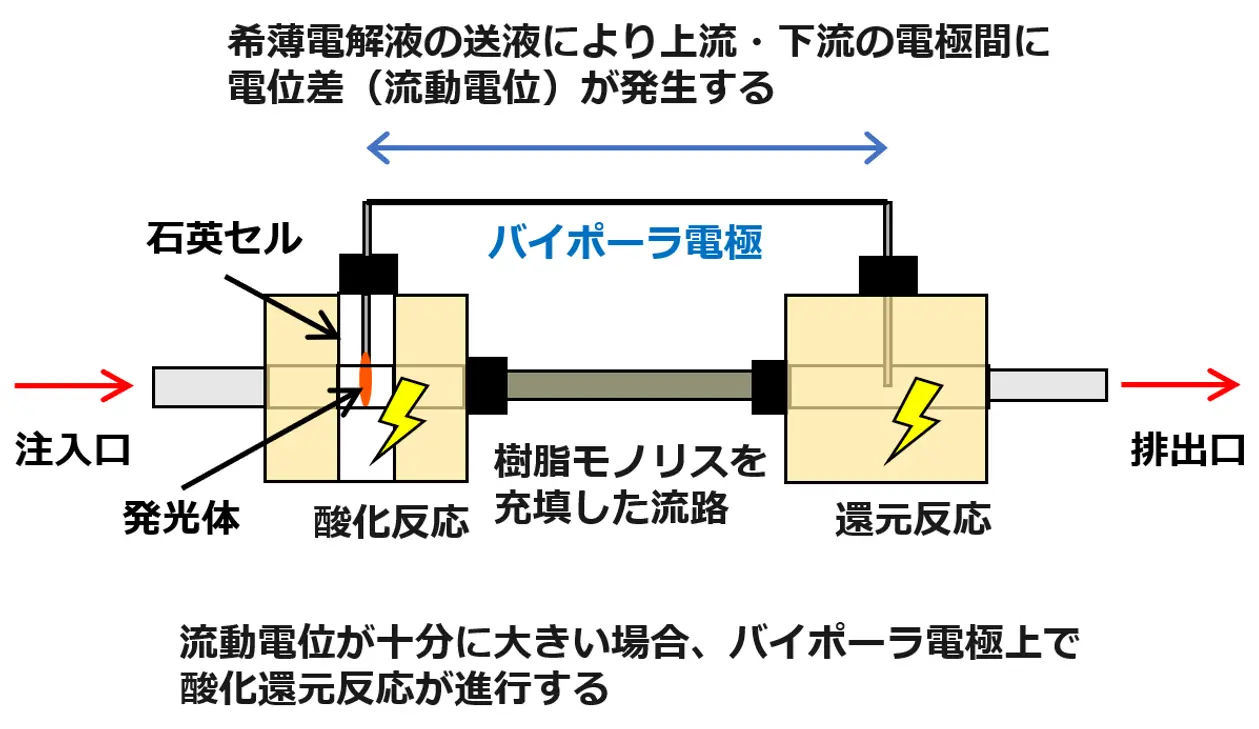
図1.電源装置を用いない無給電電気化学反応に用いる電気化学セルの図(図2の写真にも対応)
<関連情報>
- https://www.isct.ac.jp/ja/news/updqxdguidnv
- https://www.isct.ac.jp/plugins/cms/component_download_file.php?type=2&pageId=&contentsId=1&contentsDataId=2184&prevId=&key=f8d290d5fe870c64829e0aa35bfaaa94.pdf
- https://www.nature.com/articles/s41467-025-63548-2
流動溶液中のアミン検出のための流動電位駆動型電気化学発光装置 An electrochemiluminescence device powered by streaming potential for the detection of amines in flowing solution
Rintaro Suzuki,Suguru Iwai,Ryota Kirino,Kosuke Sato,Mariko Konishi,George Hasegawa,Norio Ishizuka,Kimihiro Matsukawa,Kazuo Tanaka,Elena Villani & Shinsuke Inagi
Nature Communications Published:08 September 2025
DOI:https://doi.org/10.1038/s41467-025-63548-2
Abstract
The research and implementation of portable and low-cost analytical devices that possess high reproducibility and ease of operation is still a challenging task, and a growing field of importance, within the analytical research. Herein, we report the concept, design and optimization of a microfluidic device based on electrochemiluminescence (ECL) detection that can be potentially operated without electricity for analytical purposes. The device functions exploiting the concept of streaming potential-driven bipolar electrochemistry, where a potential difference, generated from the flow of an electrolyte through a microchannel under the influence of a pressure gradient, is the driving force for redox reactions. To our purpose, we employ such a device to drive the ECL reaction of an organic chromophore deposited onto the electrode surface by simply flowing an electrolytic solution containing a coreactant into the microfluidic system, and we successively apply such device for the detection of amines in water. Our device shows high reproducibility and satisfactory detection limits for tri-n-propylamine, demonstrating an original, and up to now unexplored, concept of energy saving microfluidic systems with integrated ECL detection.