2025-09-05 東京科学大学
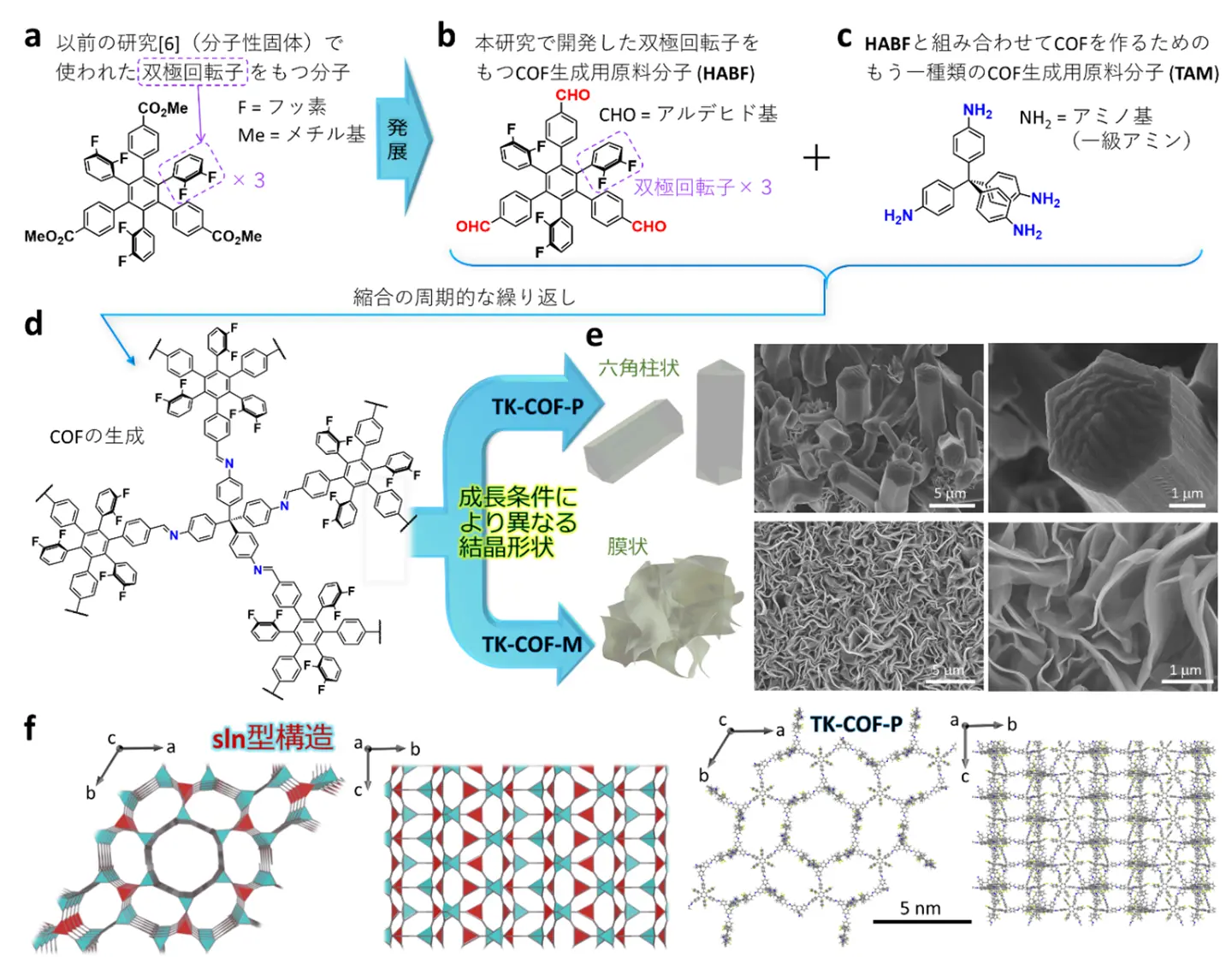
図 1. (a)分子性固体の先行研究[参考文献6]で用いられた双極回転子をもつ分子。(b)本研究の目的のために(a)の分子を発展させた、本研究で開発したCOF生成用原料分子HABF。(c)HABFと組み合わせてCOFを生成するために選定したCOF生成用原料分子TAM。(d)HABFとTAMとを繰り返し縮合させることにより形成したCOFの共有結合ネットワーク。(e)本研究で開発した二種類の新COF(六角柱状結晶:TK-COF-P、膜状結晶:TK-COF-M)の走査型電子顕微鏡像。(f)X線構造解析によって判明したこれらのCOFがもつsln型構造の模式図(左)およびTK-COF-Pの構造(右)。
<関連情報>
- https://www.isct.ac.jp/ja/news/zedur86wfw65
- https://www.isct.ac.jp/plugins/cms/component_download_file.php?type=2&pageId=&contentsId=1&contentsDataId=2207&prevId=&key=0c81a807328f5aadb6270a9929b909a7.pdf
- https://pubs.acs.org/doi/10.1021/jacs.5c10010
形状二形性と双極子ローターを有するsln-トポロジカル共有結合性有機構造体 sln-Topological Covalent Organic Frameworks with Shape Dimorphism and Dipolar Rotors
Xiaohan Wang,Syunto Goto,Takejiro Ogawa,Takuya Miyazaki,Kouki Kawamura,Atsuko Kosaka,Hiroaki Suzuki,Wang Zhang,Koji Yazawa,Yutaro Ogaeri,Takayuki Kamihara,Kiyohiro Adachi,Daisuke Hashizume,Yukihito Kondo,Takumi Sannomiya,Hidehiro Uekusa,Masaki Kawano,Ryosuke Takehara,Yoshiaki Shoji,Takanori Fukushima,and Yoichi Murakami
Journal of the American Chemical Society Published August 14, 2025
DOI:https://doi.org/10.1021/jacs.5c10010
Abstract
We report herein the first (i) covalent organic frameworks (COFs) with sln topology, (ii) drastic control of the shape of COF crystals with the same topology and chemical composition, (iii) insight that these different shapes are accompanied by conformational isomerism, and (iv) installation of dipolar rotors into three-dimensional (3D) COFs. We used a new building block, hexaarylbenzene with three dipolar 1,2-difluorophenyls. Depending on the solution composition, we generated two types of COF crystals with different shapes: hexagonal prism (TK-COF-P) and membrane (TK-COF-M). Although they exhibit distinctly different powder X-ray diffraction patterns, they are chemically identical. The structural determinations revealed that they have a low-symmetric, low-density sln topology that is yet to be reported for COFs. The two distinct shapes─shape dimorphism─is found to accompany conformational isomerism. Temperature-dependent dielectric and 19F NMR relaxation-time measurements reveal that the rotor motion is suppressed at room temperature, but the rotors respond to an external electric field at elevated temperatures owing to the high activation energy for rotation (∼20 kcal mol–1), which is desired for room-temperature applications including molecular memories. These outcomes have not only expanded the diversity of COFs but have also provided a foundation for installing external-field-responsive functions into COFs that have high thermal stability, which is expected to invoke broad applications.