

2025-09-03 物質・材料研究機構,東北大学,産業技術総合研究所
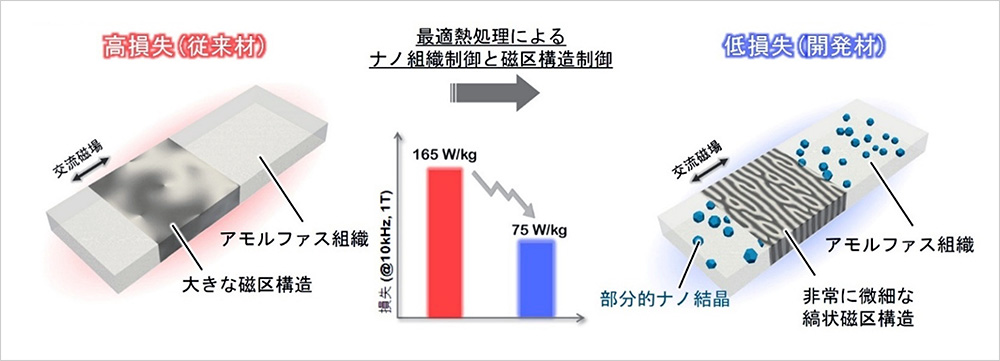
図: 従来のアモルファスリボンのナノ組織と磁区構造(左)と、本開発材料のナノ組織制御および磁区構造制御(右)の模式図。
中央のグラフは、これらの制御によって軟磁性材料の電力損失を50%以上低減できたことを示している。
<関連情報>
- https://www.nims.go.jp/press/2025/09/202509030.html
- https://www.nims.go.jp/press/2025/09/lf77c00000004gsi-att/202509030.pdf
- https://www.nature.com/articles/s41467-025-63139-1
ナノ構造と高周波領域設計による鉄増強軟磁性リボンにおける超低コア損失の実現 Ultra-low core loss in Fe-enriched soft magnetic ribbons enabled by nanostructure and high-frequency domain engineering
Ravi Gautam,Shozo Hiramoto,Nikita Kulesh,Hiroaki Mamiya,Satoshi Okamoto,Nobuhisa Ono,Takeshi Ogasawara,Tadakatsu Ohkubo & Hossein Sepehri-Amin
Nature Communications Published:03 September 2025
DOI:https://doi.org/10.1038/s41467-025-63139-1
Abstract
The next generation of power electronics necessitates materials capable of rapid response at tens of kilohertz frequencies while ensuring minimal core losses. Accelerating the advancement of power electronics hinges on addressing the current shortage of ultra-low core loss soft magnets, thereby enabling sustainable energy utilization and paving the way toward achieving zero carbon footprints. Here we demonstrate an approach that integrates nanostructure engineering with high-frequency domain structure control, significantly enhancing the performance of Fe-enriched amorphous ribbons. Our strategy reduces core loss by 55%, achieving an ultra-low loss of ~ 75 ± 1.3 W/kg at 10 kHz, 1 T. We attribute this improvement to optimized perpendicular magnetic anisotropy, which is induced by positive magnetostriction and compressive stress generated from partial nanocrystallization of α-Fe in a residual amorphous matrix. These configurations lead to the formation of a narrow stripe-shaped magnetic domain (~ 4.8 ± 0.6 μm wide), resulting in minimal excess loss. These findings highlight a pivotal advancement in soft magnet design, facilitating energy-efficient, miniaturized power electronics for modern applications.
