2025-08-27 イリノイ大学アーバナ・シャンペーン校
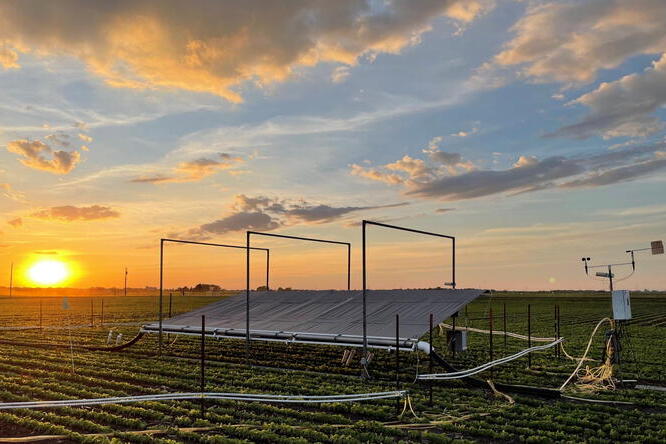
Researchers used the SoyFACE facility at U. of I. to expose soybeans to elevated ozone while excluding rainfall, finding both decreased yield. Photo by Duncan Martin.
<関連情報>
- https://aces.illinois.edu/news/how-drought-and-ozone-pollution-team-reduce-soybean-yield
- https://academic.oup.com/plphys/advance-article-abstract/doi/10.1093/plphys/kiaf350/8232742
干ばつはオゾン濃度上昇による大豆の光合成と収量減少を緩和しない Drought does not mitigate reductions in soybean photosynthesis and yield caused by elevated ozone
Duncan G Martin , Elise K Aspray , Shuai Li , Andrew D B Leakey , Elizabeth A Ainsworth
Plant Physiology Published:12 August 2025
DOI:https://doi.org/10.1093/plphys/kiaf350
Abstract
The co-occurrence of elevated tropospheric ozone concentrations and drought in agricultural regions is anticipated to increase with climate change. Both stressors negatively impact leaf photosynthetic capacity and stomatal conductance, contributing to reductions in biomass and yield. The interaction of ozone and drought stress is complex and under-researched, particularly in field settings. Stomatal closure in response to soil drying may provide protection from high ozone influx to leaves. Conversely, elevated ozone may prevent drought-induced stomatal closure, leading to depletion of soil water resources and exacerbation of drought stress. Here, we used Free Air Concentration Enrichment of ozone (100 ppb) and rainfall exclusion canopies (intercepting ∼40% of seasonal rainfall) to test potential interaction effects of elevated ozone and drought stress on soybean (Glycine max) leaf-level physiology and yield. Elevated ozone consistently reduced soybean Rubisco carboxylation capacity (-17%) and maximum electron transport capacity (-9%) across three years of study. Elevated ozone did not alter the relationships between soil moisture, abscisic acid, and stomatal conductance. Thus, there was no evidence indicating that ozone exposure prevented stomata from responding during drought. Yield was significantly reduced in soybeans exposed to elevated ozone, resulting from fewer seeds per plot and reduced seed size. The reduced precipitation treatment only affected yields in the driest growing season. These findings suggest that the effects of elevated ozone and drought are additive, rather than interactive, and dose dependent. The persistence of ozone damage under soil moisture depletion is likely to be exacerbated by global climate change.