2025-07-24 中国科学院(CAS)
<関連情報>
- https://english.cas.cn/newsroom/research_news/chem/202507/t20250725_1048511.shtml
- https://pubs.acs.org/doi/10.1021/jacs.5c06375
五重対称性双晶媒介の融合における原子スケールダイナミクス:経路依存性と欠陥支配の非古典的成長メカニズム Atomic-Scale Dynamics of Five-Fold Twin Mediated Coalescence: Pathway-Dependent and Defect-Governed Nonclassical Growth Mechanisms
Hongshan Wang,Miriding Mutailipu,Loukya Boddapati,Amit Samanta,Francis Leonard Deepak,and Junjie Li
Journal of the American Chemical Society Published: June 9, 2025
DOI:https://doi.org/10.1021/jacs.5c06375
Abstract
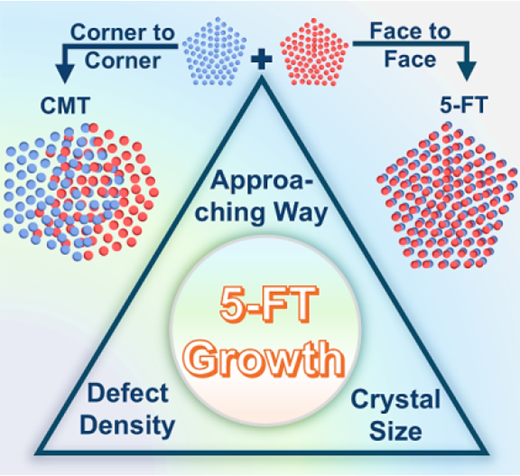
Defective crystals with distinct properties have been discovered in many systems. However, the growth mechanism of defective crystals is still poorly understood. Here, using a 5-fold twinned gold (Au) nanocrystal (NC) as a model system, three new coalescence pathways involving detwinning or twinning have been uncovered through atomic-scale dynamic observations in an aberration-corrected transmission electron microscope coupled with atomistic simulations. This demonstrates that beyond crystal size, coalescence growth dynamics involving 5-fold twins (5-FTs) are highly dependent on crystal defect density and the approach pathways of the crystals. When a 5-FT encounters a smaller 5-FT or a smaller NC in a face-to-face way, a new, larger 5-FT is produced at a relatively fast coalescence growth rate; while in a corner-to-corner way, the coalescence dynamics are more retarded and sluggish, which is conducive to the formation of complex multitwined structures rather than 5-FTs. This highlights that the planar defect density and crystal approach pathway influence the coalescence dynamics of crystals containing 5-FT. Moreover, a column-by-column grain boundary (GB) migration mechanism, which results in bent GBs, was also unveiled during the crystal coalescence process. These results enrich the general understanding of the crystal growth theory and provide new insights into the controllable fabrication of 5-FTs by crystal coalescence mechanisms.