2025-07-15 NASA
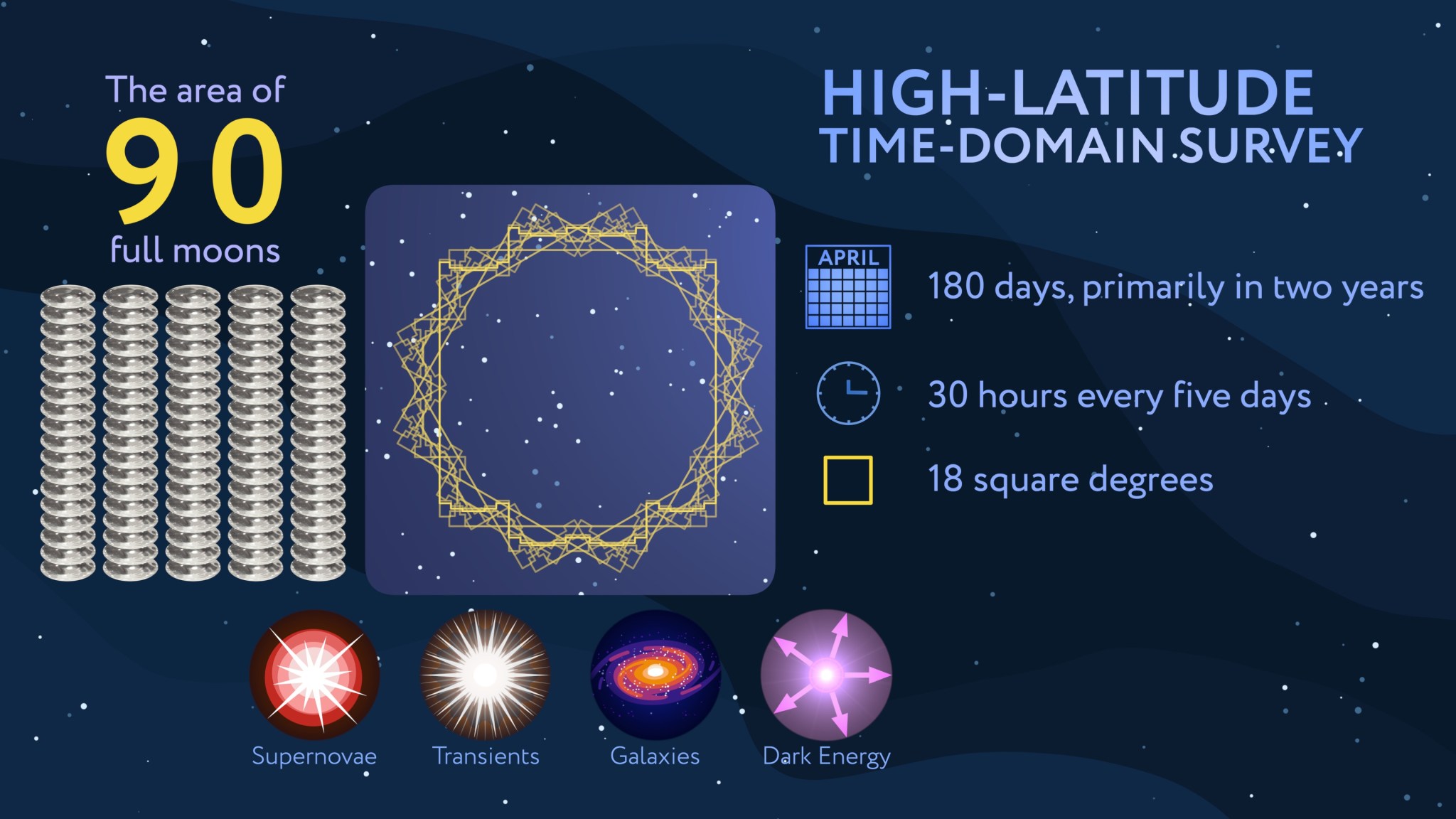 This infographic describes the High-Latitude Time-Domain Survey that will be conducted by NASA’s Nancy Grace Roman Space Telescope. The survey’s main component will cover over 18 square degrees — a region of sky as large as 90 full moons — and see supernovae that occurred up to about 8 billion years ago. Smaller areas within the survey will pierce even farther, potentially back to when the universe was around a billion years old. The survey will be split between the northern and southern hemispheres, located in regions of the sky that will be continuously visible to Roman. The bulk of the survey will consist of 30-hour observations every five days for two years in the middle of Roman’s five-year primary mission. Credit: NASA’s Goddard Space Flight Center
<関連情報>
- https://www.nasa.gov/missions/roman-space-telescope/one-survey-by-nasas-roman-could-unveil-100000-cosmic-explosions/
- https://iopscience.iop.org/article/10.3847/1538-4357/ade1d6
砂時計シミュレーション:ローマ高緯度時間領域コアコミュニティ調査のカタログ The Hourglass Simulation: A Catalog for the Roman High-latitude Time-domain Core Community Survey
B. M. Rose, M. Vincenzi, R. Hounsell, H. Qu, L. Aldoroty, D. Scolnic, R. Kessler, P. Macias, D. Brout, M. Acevedo,…
The Astrophysical Journal Published: 2025 July 15
DOI:10.3847/1538-4357/ade1d6
Abstract
We present a simulation of the time-domain catalog for the Nancy Grace Roman Space Telescope’s High-Latitude Time-Domain Core Community Survey. This simulation, called the Hourglass simulation, uses the most up-to-date spectral energy distribution models and rate measurements for 10 extragalactic time-domain sources. We simulate these models through the design reference Roman Space Telescope survey: four filters per tier, a five-day cadence, over 2 yr, a wide tier of 19 deg2, and a deep tier of 4.2 deg2, with ∼20% of those areas also covered with prism observations. We find that a science-independent Roman time-domain catalog, assuming a signal-to-noise ratio at a max of >5, would have approximately 21,000 Type Ia supernovae, 40,000 core-collapse supernovae, around 70 superluminous supernovae, ∼35 tidal disruption events, three kilonovae, and possibly pair-instability supernovae. In total, Hourglass has over 64,000 transient objects, 11,000,000 photometric observations, and 500,000 spectra. Additionally, Hourglass is a useful data set to train machine learning classification algorithms. We show that SCONE is able to photometrically classify Type Ia supernovae with high precision (∼95%) to a z > 2. Finally, we present the first realistic simulations of non-Type Ia supernovae spectral time series data from Roman’s prism.