
2025-07-08 中国科学院(CAS)
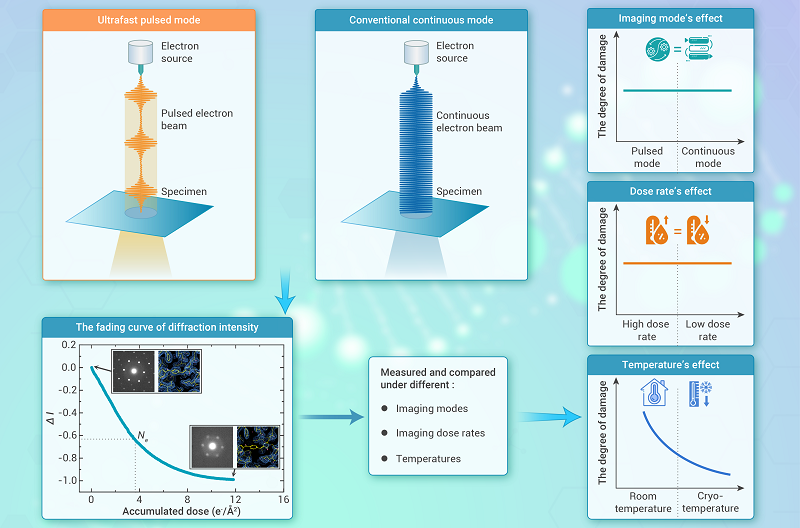
Schematic diagram of electron radiation damage detection in saturated aliphatic hydrocarbon C44H90 crystals (Image by SUN Fei’s group)
<関連情報>
- https://english.cas.cn/newsroom/research_news/life/202507/t20250711_1047267.shtml
- https://www.the-innovation.org/article/doi/10.59717/j.xinn-life.2025.100145
超高速クライオ電子顕微鏡(クライオUEM)におけるソフトマターの放射線損傷挙動 Radiation damage behavior of soft matter in ultrafast cryo-electron microscopy (cryo-UEM)
Yimin Zhao, Chen Qi, Chunhui Zhu, Yun Zhu, Yongzhao Zhang, Tongnian Gu, Huanfang Tian, Wentao Wang, Siyuan Huang, Huaixin Yang , Jianqi Li , Fei Sun
The Innovation Life Published:02 July 2025
DOI:https://doi.org/10.59717/j.xinn-life.2025.100145
PUBLIC SUMMARY
- An ultrafast cryo-electron microscopy (cryo-UEM) system based on an ultrafast laser was established.
- Diffraction-intensity fading curves and critical doses of samples were measured under different conditions.
- The radiation damage in soft-matter samples did not show any dependence on the imaging electron dose rates.
- The pulsed electron beams cannot mitigate the radiation damage in room-temperature and cryogenic samples
- The physical mechanisms behind the experimental results of radiation damage were systematically analyzed.
ABSTRACT
Whether time-modulated pulsed-electron imaging can mitigate sample radiation damage is still controversial. The effectiveness of such mitigation and relevant potential applications in cryo-EM remain to be explored. Herein, we built an ultrafast cryo-EM system based on an ultrafast laser. Using such system and the saturated aliphatic hydrocarbon compounds (C44H90), the diffraction-intensity fading curves and corresponding critical electron doses (Ne) of samples were carefully measured under different imaging modes, temperatures, imaging dose rates and pulsed repetition rates. Our experimental results demonstrate that the fading curves and Ne values of C44H90 crystals show no correlation with the imaging electron dose rates. As the temperature decreased, the Ne values of the sample increased, indicating a cryoprotective effect on sample radiation damage. Interestingly, at constant temperature, the fading curves and Ne values of the sample in multi-electron-packet and near-single-electron-packet pulsed modes are all approximately the same as those in conventional continuous electron-beam mode, even when obtained at different pulsed repetition rates. These results show that the time-modulated pulsed electron beams do not appear to mitigate the electron radiation damage that occurs in samples. The physical mechanisms underlying the radiation damage behavior under different conditions were also carefully analyzed. Our findings provide new insights and an experimental basis for understanding sample radiation damage under electron beams, offering guidance and inspiration for elucidating the fundamental principles of radiation damage.
