2024-10-08 マサチューセッツ工科大学(MIT)
<関連情報>
- https://news.mit.edu/2024/bubble-findings-could-unlock-better-electrode-electrolyzer-designs-1008
- https://pubs.rsc.org/en/content/articlelanding/2024/nr/d4nr02628d
機械学習によって電極の気泡不活性化を発見 Machine learning-guided discovery of gas evolving electrode bubble inactivation
Jack R. Lake,Simon Rufer,Jim James,Nathan Pruyne,Aristana Scourtas,Marcus Schwarting,Aadit Ambadkar,Ian Foster,Ben Blaiszik and Kripa K. Varanasi
Nanoscale Published:08 Oct 2024
DOI:https://doi.org/10.1039/D4NR02628D
Abstract
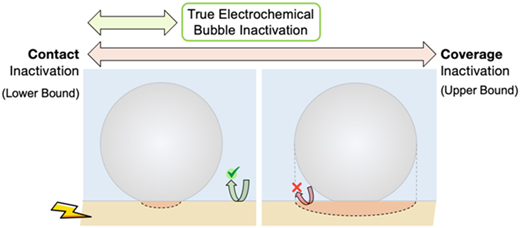
The adverse effects of electrochemical bubbles on the performance of gas-evolving electrodes are well known, but studies on the degree of adhered bubble-caused inactivation, and how inactivation changes during bubble evolution are limited. We study electrode inactivation caused by oxygen evolution while using surface engineering to control bubble formation. We find that the inactivation of the entire projected area, as is currently believed, is a poor approximation which leads to non-physical results. Using a machine learning-based image-based bubble detection method to analyze large quantities of experimental data, we show that bubble impacts are small for surface engineered electrodes which promote high bubble projected areas while maintaining low direct bubble contact. We thus propose a simple methodology for more accurately estimating the true extent of bubble inactivation, which is closer to the area which is directly in contact with the bubbles.