

2026-11-16 中国科学院(CAS)
<関連情報>
- https://english.cas.cn/newsroom/research-news/202611/t20261117_1219264.shtml
- https://iopscience.iop.org/article/10.3847/2041-8213/aeba80
GRB 221009Aから検出された2 MeVスペクトルバンプと約40 MeV輝線(Detection of 2 MeV Spectral Bump and ~40 MeV Emission Line from GRB 221009A)
Zhiqiang Ding, Zhenxia Zhang, Yanqiu Zhang, Ruize Shi, Xinqiao Li, Zhuo Li, Zhenghua An, Shaolin Xiong, Roberto Battiston, Shuangnan Zhang, Hua Feng, Dali Zhang, Yanbing Xu, Ping Wang, Xiaoyun Zhao, Yuqian Ma, Hong Lu, Xiangyang Wen, Yongjie Zhang, Xuhui Shen, Shigeng Yuan, Siquan Yang, Rongxue Kang, Chao Zheng, Yan Huang, Wen Su, Shengli Liu, Hui Wang, Xiaohua Liang, Jinzhou Wang, Ke Gong, Xiaojing Liu, Yaqing Liu, Sheng Yang, Zeren Zhima, Jianping Huang, Wei Chu, Na Zhou, Roberto Iuppa, Francesco Maria Follega, Marco Cristoforetti, Wangchen Xue, Lu Wang, Jiaqi Zheng, Jiacong Liu, Chenwei Wang, Wenjun Tan, Zhenghang Yu, Shujie Li, Hao Hong
The Astrophysical Journal Letters :2026年11月13日 arXiv公開日:2026年11月11日(v1)
DOI:10.3847/2041-8213/aeba80
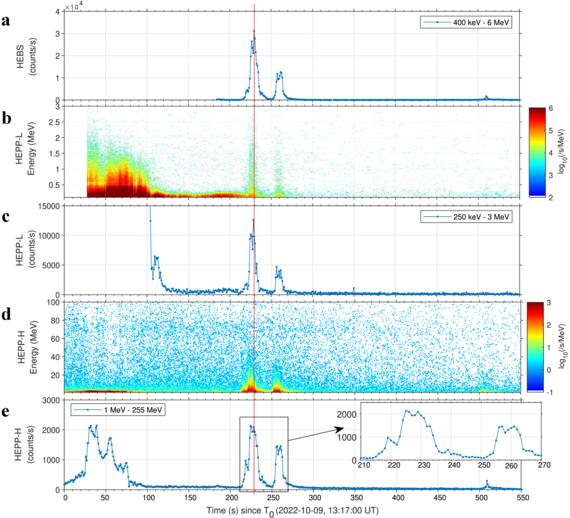
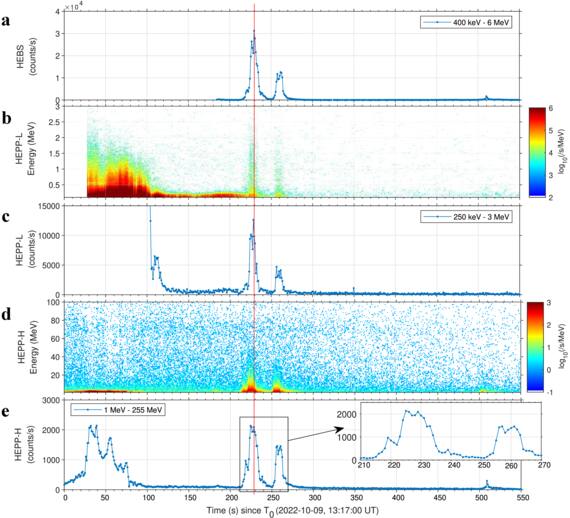
Figure 1. Temporal evolution of GRB 221009A observed by GECAM-C (HEBS) and CSES-01. (a) The light curve from GECAM-C in the 400 keV–6 MeV range, showing the primary gamma-ray emission. The GECAM-C data are shown starting from approximately Tref + 180 s because the preceding interval was contaminated by high background due to the high-latitude effect (Z.-H. An et al. 2023). Panels (a) and (c) show the energy-time spectrogram and integrated light curve (250 keV–3 MeV) of the secondary particles detected by HEPP-L, respectively. Panels (d) and (e) show the corresponding spectrogram and integrated light curve (1–255 MeV) from HEPP-H, respectively. The vertical red line marks the time of the main emission peak. IOPscience CC BY 4.0
5. English
This study investigates GRB 221009A (the BOAT), the brightest gamma-ray burst ever observed, using unsaturated measurements from the HEPP-H high-energy detector aboard the CSES-01 satellite. By combining these observations with GECAM-C and Fermi data, the researchers reconstructed the continuous spectral evolution of the burst over the 2–255 MeV energy range. Conventional gamma-ray detectors suffered severe saturation under the exceptionally high photon flux, but this limitation was overcome using the secondary-electron detection mechanism of HEPP-H and a dynamic correction framework that reproduced the detector’s data-acquisition process. The analysis revealed an unusual spectral bump at approximately 2 MeV during the main emission peak, between 225 and 235 seconds after the reference time, which could not be adequately explained by the standard Band spectrum. This component was comparably described by either a blackbody or a cutoff power-law model and may originate from photospheric thermal emission during the acceleration phase of a relativistic fireball. Its integrated energy accounts for only approximately 6% of the total gamma-ray energy release, suggesting that the bulk of the prompt emission is powered by a magnetically dominated jet. The researchers also identified a narrow emission line initially centered near 40 MeV during the decay phase. Its energy decreases according to Eline ∝(t-t0)-1.05. The line detection reaches approximately 4σ significance in the 242–251 s interval and exceeds 4.5σ in the 246–256 s interval. A combined sliding-window analysis further establishes a global significance exceeding 4.4σ through Monte Carlo simulations. The line may originate from electron–positron pair annihilation. Its distinctive rise-then-fall flux evolution suggests an angularly structured jet with a relatively weak magnetic field near the central axis and stronger magnetic fields at higher latitudes, forming a ring-like magnetic structure. These findings provide new observational constraints on the central engine and the formation and radiation mechanisms of relativistic jets in gamma-ray bursts.

