2026-05-28 ミュンヘン大学(LMU)
<関連情報>
- https://www.lmu.de/en/newsroom/news-overview/news/quantum-physics-a-matter-of-bonding-358e7fe1.html
- https://www.nature.com/articles/s41467-026-73527-w
化学結合の概念は、最大限に絡み合った原子軌道から自然に生じる Chemical bonding concepts emerge naturally from maximally entangled atomic orbitals
Lexin Ding,Eduard Matito & Christian Schilling
Nature Communications Published:27 May 2026
DOI:https://doi.org/10.1038/s41467-026-73527-w
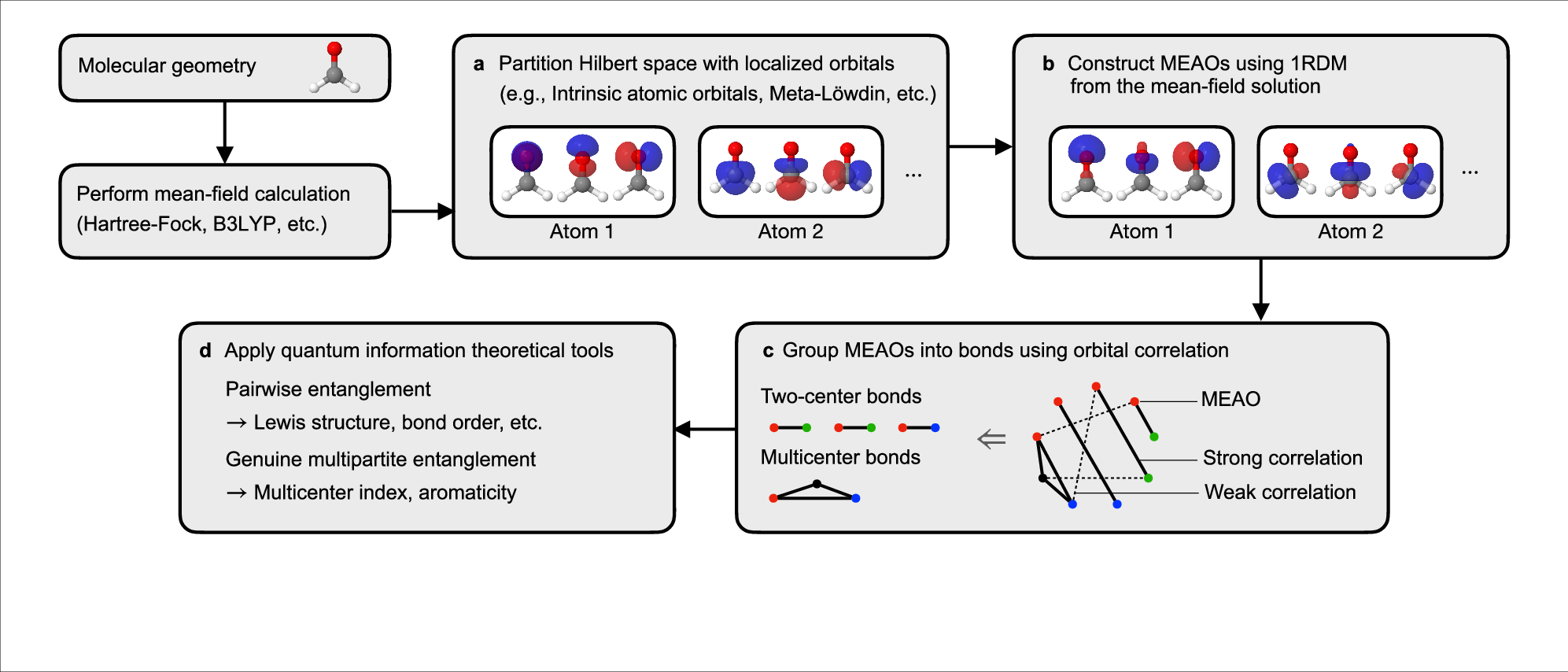
Abstract
Chemical bonding is a nonlocal phenomenon that binds atoms into molecules. Its ubiquitous presence in chemistry, however, stands in stark contrast to its ambiguous definition and the lack of a universal perspective for its understanding. In this work, we rationalize and characterize chemical bonding through the lens of an equally nonlocal concept from quantum information, the orbital entanglement. We introduce the maximally entangled atomic orbitals (MEAOs) whose entanglement pattern is shown to recover both Lewis (two-center) and beyond-Lewis (multicenter) structures, with multipartite entanglement serving as a comprehensive index of bond strength. Our unifying framework for bonding analyses is effective not only for equilibrium geometries but also for transition states in chemical reactions and complex phenomena such as aromaticity. It also has the potential to elevate the Hilbert space atomic partitioning to match the prevalent real-space partitioning in the theory of atoms in molecules. Accordingly, our work provides a new framework for understanding fuzzy chemical concepts using rigorous, quantitative descriptors from quantum information.