2026-10-28 福井県立大学
北海道大学、福井県立大学、福井県立恐竜博物館の研究チームは、福井県勝山市の北谷恐竜発掘現場で採取された約1億2,000万年前(前期白亜紀)の植物化石から、有機分子の痕跡を検出し、化石植物の分類や進化を探る新たな手法を示した。植物化石は葉や枝だけでは分類が難しい場合があるため、研究チームは4点の化石に残る化学成分を分析し、現生植物などの成分と比較した。その結果、針葉樹類のブラキフィルム化石から、現在は主に南半球に分布するナンヨウスギ科の植物に特徴的な化学成分が見つかり、白亜紀の日本にもその仲間が生育していたことが支持された。また、絶滅した裸子植物ベネチテス類のタイロフィルム化石からは、針葉樹類の樹脂にも含まれるピマラン型化合物が検出された。これは両者が近縁であるという仮説を、化学的証拠から支持する成果である。化石に残る分子を「分子化石」として利用することで、形態だけでは分類できない植物片からも過去の植生や生態系を復元できる可能性が広がる。
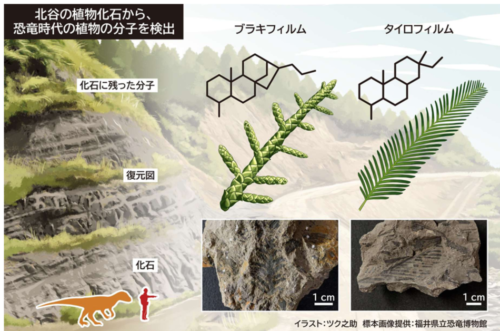
図1 北谷の植物化石と復元図、化石に残っていた分子の構造(推定を含む)。左はブラキフィルム(針葉樹類)の枝葉、 右はタイロフィルム(ベネチテス類)の葉。背景は、化石が産出した北谷恐竜発掘現場の露頭を描いたイラストです。
<関連情報>
- https://www.fpu.ac.jp/press-release/q156806_d/fil/file1.pdf
- https://www.sciencedirect.com/science/article/abs/pii/S0146638026001890
下部白亜系北谷層の植物化石に含まれる側鎖伸⾧型四環性ジテルパンと、側鎖伸⾧型を含むピマラン型ジテルペノイド:化学分類学的および続成作用上の意義 Extended tetracyclic diterpanes and pimarane-type diterpenoids from Lower Cretaceous plant fossils (Kitadani Formation, Japan): chemotaxonomic and diagenetic implications
Hiroki Yano,Hideto Nakamura,Hirokazu Yukawa
Organic Geochemistry Available online: 25 September 2026
DOI:https://doi.org/10.1016/j.orggeochem.2026.105314
Highlights
- Aliphatic plant biomarkers were studied in four Mesozoic plant fossils.
- Tentatively identified extended tetracyclic diterpanes dominate in Brachyphyllum sp.
- Extended tetracyclic diterpanes likely formed via thermal alkylation.
- Conifer-like terpenoid biosynthesis is suggested in a bennettitalean specimen.
Abstract
Aliphatic terpenoid biomarkers in four fossil plant samples from the Lower Cretaceous Kitadani Formation were analyzed by gas chromatography–mass spectrometry (GC–MS) to advance understanding of Mesozoic plant chemotaxonomy. Fossil–host rock comparisons were used to evaluate the indigenous origin of biomarkers. Gymnosperm fossils yielded much higher concentrations of n-alkanes and diterpenoids than fern fossils. Brachyphyllum showed a distinctive dominance of tetracyclic diterpanes, including homologues with elongated side-chain structures, whereas Ptilophyllum was enriched in pimarane-type diterpenoids. Fern fossils contained only trace amounts of terpenoids. Biomarker maturity indices (C31 hopane 22S/(22S + 22R) ≈ 0.62; MPI-1 and MPR-derived Rc ≈ 0.86%) indicate oil-window maturity. The selective enrichment of tetracyclic diterpanes in Brachyphyllum is consistent with non-Pinaceae conifers, while the pimarane dominance in Ptilophyllum suggests a Bennettitalean chemotaxonomic signal resembling conifers. The extended tetracyclic and pimarane diterpanes likely represent diagenetic products formed by thermal alkylation of conifer-type precursors; their structures remain tentative. These results demonstrate that diagnostic plant terpenoids persisted in the analyzed gymnosperm fossils even at high maturity, providing preliminary paleochemotaxonomic constraints for Mesozoic floras at Kitadani Dinosaur Quarry. Further structural confirmation (e.g., GC × GC–MS) and broader sampling are required to generalize these patterns.