2026-07-10 合肥物質科学研究院(HFIPS)
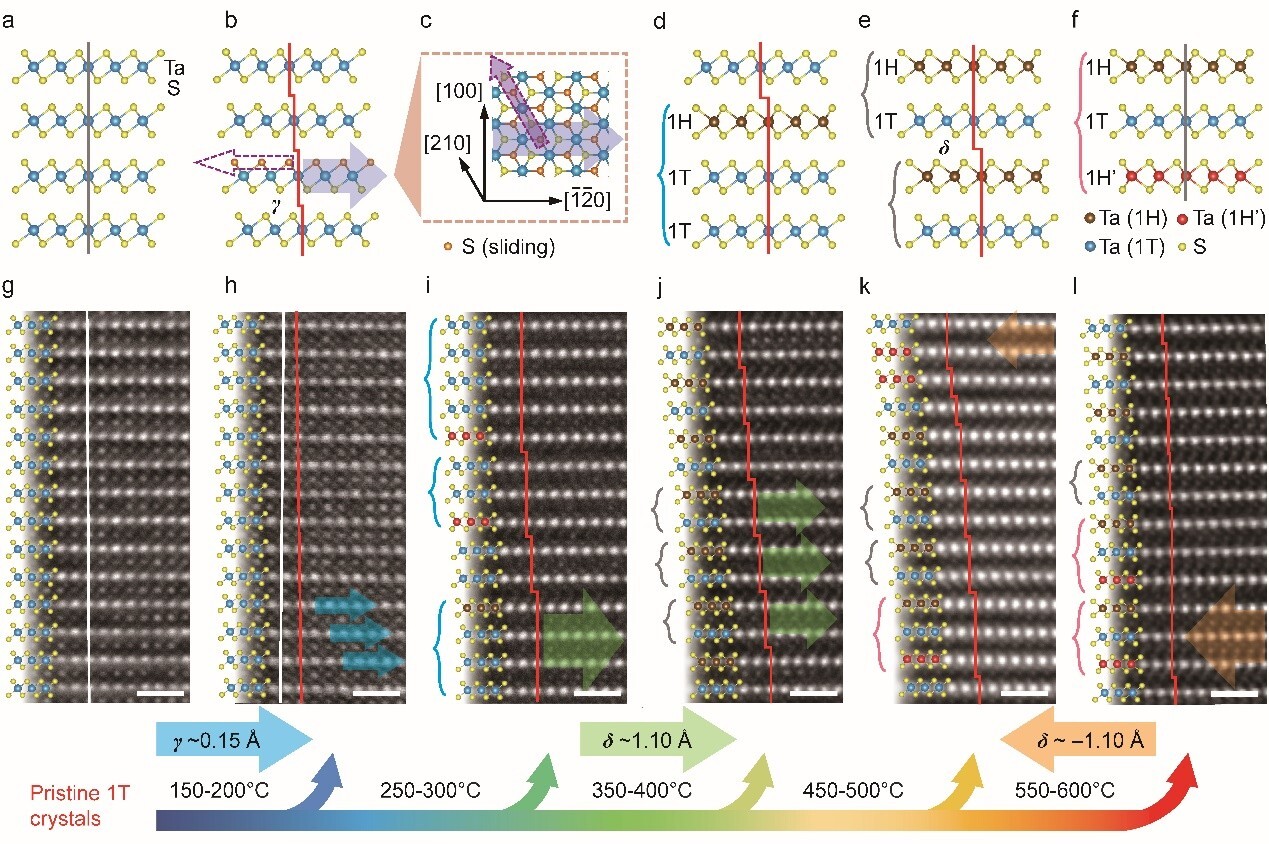
Schematic illustrations of programmable superlattices (Image by CAO Liang)
<関連情報>
- https://english.hf.cas.cn/nr/rn/202607/t20260710_1176953.html
- https://academic.oup.com/nsr/article/13/11/nwag246/8664328
- https://www.nature.com/articles/s41467-024-47728-0
層分解型1T-1H変換による TaS₂ における自己適応型ヘテロ相超格子 Self-adaptive hetero-phase superlattices in TaS2 via layer-resolved 1T-to-1H transformations
Zhenyu Ding,Yihao Wang,Rui Li,Jingjing Gao,Jialiang Jiang,Jin Tang,Yuyan Han,Qian Xu,Junfa Zhu,Wenqian Tu,…
National Science Review Published:28 April 2026
DOI:https://doi.org/10.1093/nsr/nwag246
ABSTRACT
Artificial hetero-phase superlattices constructed from transition metal dichalcogenides (TMDs) provide a powerful platform for exploring exotic physical phenomena and delivering structurally robust devices. However, achieving deterministic control over phase-stacking sequences in bulk architectures remains a significant challenge. Here, we report a self-adaptive superlattice system formed in TaS2 crystals through an in-situ structural phase transition. Coordinated inter-layer sliding and intra-layer S-plane sliding drive layer-resolved 1T-to-1H transformations. This two-dimensional transformation pathway enables deterministic and dynamic engineering of hetero-phase sequences within a three-dimensional (3D) crystal, with the resulting interfaces stabilized by persistent inter-phase coupling. Within these reconfigurable superlattices, we identify two distinct superconducting states arising from paired 1H/1T bilayers and sandwiched 1H/1T/1H’ trilayers. The charge density wave order remaining in the 1T layer suppresses superconductivity in the 1H/1T superlattice. Our findings establish an in–situ, sequence-controllable phase engineering strategy for constructing bulk TMD hetero-phase homostructures and highlight stacking configuration as a powerful degree of freedom for designing TMD-based quantum materials and devices.
1T-TaS₂結晶における二重絶縁体状態 Dualistic insulator states in 1T-TaS2 crystals
Yihao Wang,Zhihao Li,Xuan Luo,Jingjing Gao,Yuyan Han,Jialiang Jiang,Jin Tang,Huanxin Ju,Tongrui Li,Run Lv,Shengtao Cui,Yingguo Yang,Yuping Sun,Junfa Zhu,Xingyu Gao,Wenjian Lu,Zhe Sun,Hai Xu,Yimin Xiong & Liang Cao
Nature Communications Published:23 April 2024
DOI:https://doi.org/10.1038/s41467-024-47728-0
Abstract
While the monolayer sheet is well-established as a Mott-insulator with a finite energy gap, the insulating nature of bulk 1T-TaS2 crystals remains ambiguous due to their varying dimensionalities and alterable interlayer coupling. In this study, we present a unique approach to unlock the intertwined two-dimensional Mott-insulator and three-dimensional band-insulator states in bulk 1T-TaS2 crystals by structuring a laddering stack along the out-of-plane direction. Through modulating the interlayer coupling, the insulating nature can be switched between band-insulator and Mott-insulator mechanisms. Our findings demonstrate the duality of insulating nature in 1T-TaS2 crystals. By manipulating the translational degree of freedom in layered crystals, our discovery presents a promising strategy for exploring fascinating physics, independent of their dimensionality, thereby offering a “three-dimensional” control for the era of slidetronics.