2026-05-07 中国科学院(CAS)
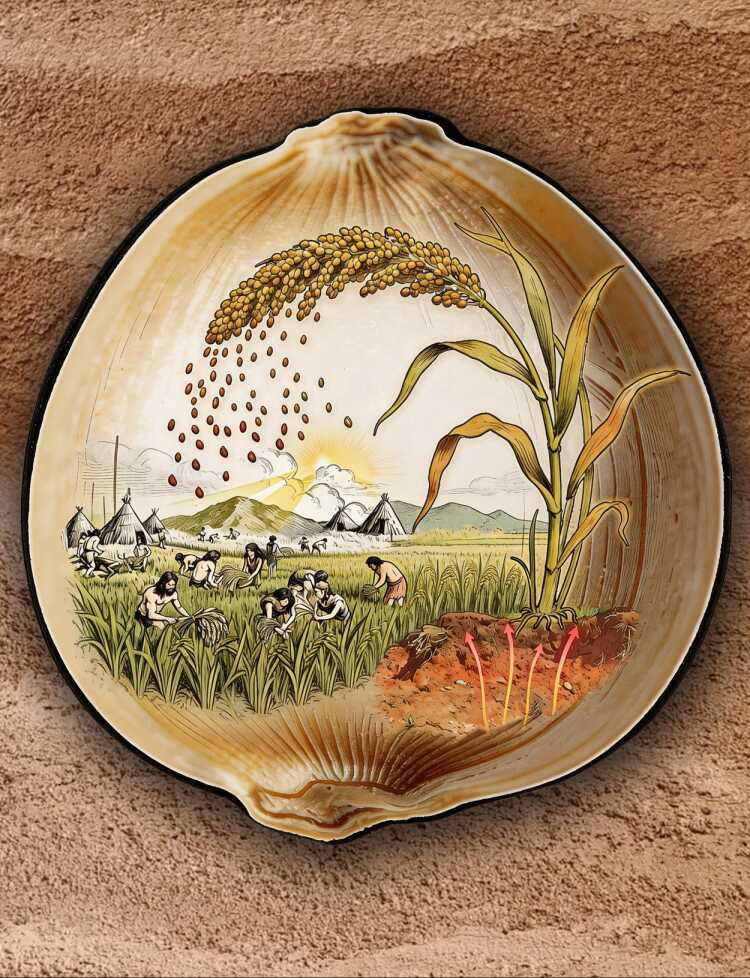
A cartoon showing a thriving millet-based agricultural society in East Asia under conditions of rising soil temperatures (Image by DONG Guanghui)
<関連情報>
- https://english.cas.cn/newsroom/research-news/202605/t20260507_1158580.shtml
- https://www.pnas.org/doi/10.1073/pnas.2529151123
土壌温度の変動が新石器時代の東アジアにおけるキビ栽培の進化を左右した Soil temperature fluctuations modulated millet agriculture evolution in Neolithic East Asia
Yongxiu Lu, Jiaoyang Ruan, Ruiliang Liu, +8 , and Guanghui Dong
Proceedings of the National Academy of Sciences Published:May 4, 2026
DOI:https://doi.org/10.1073/pnas.2529151123
Significance
Agriculture was the critical intermediary through which climate change influenced the trajectory of ancient civilizations, yet the mechanisms linking environmental shifts and early farming practices remain poorly delineated. In Neolithic East Asia, the spatiotemporal development of millet agriculture does not align with patterns of precipitation and air temperature alone. Here, we reconstruct Holocene growing-season soil temperature from biomarker proxies and indicate that mid-Holocene soil cooling likely compressed thermally suitable zones for millet cultivation, contributing to a southward displacement of farming and delaying large-scale agricultural expansion until subsequent warming. These results highlight the importance of growing-season soil temperature as a key climatic constraint operating alongside social and technological factors in shaping the trajectories of early millet agriculture.
Abstract
Millet agriculture was foundational to the emergence of complex societies in Neolithic East Asia, yet the environmental mechanisms shaping its spatiotemporal development remain unresolved. Here, we present a high-resolution reconstruction of Holocene growing-season soil temperature from biomarker proxies in a precisely dated loess sequence from the central Chinese Loess Plateau. Our data reveal a pronounced ~3 °C soil cooling between ~7.5 to 6.0 thousand years B.P. (kyr B.P.), followed by rapid warming and millennia-long relatively stable conditions. By integrating archaeological datasets with transient climate simulations, we show that this mid-Holocene soil cooling which reflects coupled climatic forcing and vegetation-related land surface changes likely compressed the thermally suitable niche for frost-sensitive millets, contributing to a southward displacement of cultivation and delaying large-scale agricultural expansion until the subsequent soil temperature recovery after ~6.0 kyr B.P. These findings suggest that large-amplitude soil temperature fluctuations acted as a modulating climatic constraint on the geographic distribution and development trajectory of millet agriculture in East Asia, providing refined insights into climate–society interactions during the Neolithic.