2026-03-17 レンセラー工科大学(RPI)
<関連情報>
- https://news.rpi.edu/2026/03/17/scientists-create-new-state-matter-room-temperature-using-light-and-nanostructures
- https://www.nature.com/articles/s41565-026-02141-0
ハイブリッドペロブスカイト・ナノグレーティングフォトニック構造により、室温での超固体化が可能になる Hybrid perovskite–nanograting photonic architecture enables supersolidity at room temperature
Yilin Meng,Wei Li,Kai Peng,Chaoyang Ti,Jianchen Dang,Xiaolong Wu,Xu Han & Wei Bao
Nature Nanotechnology Published:16 March 2026
DOI:https://doi.org/10.1038/s41565-026-02141-0
Abstract
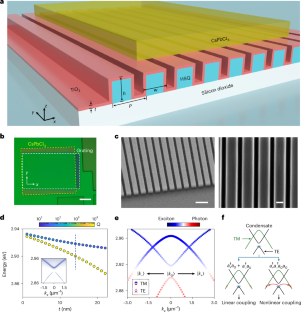
The supersolid phase is a self-organized state of matter that simultaneously exhibits the crystalline order of a solid and the frictionless flow of a superfluid. Its formation requires the simultaneous breaking of phase and translational symmetries—a stringent condition that makes experimental observation challenging. Here we show that it is possible to achieve a room-temperature supersolid phase by integrating single-crystal halide perovskites with an exciton–polariton nanograting. This architecture supports a hybrid polaritonic bound-state-in-continuum state with a large bandgap (18.2 meV) and two side modes. As the pumping intensity increases, optical parametric oscillation drives the system from a bound-state-in-continuum polariton condensate into the two side modes, forming a self-organized supersolid phase characterized by a striped one-dimensional lattice spanning the condensate. Crucially, single-shot real-space imaging shows stochastic phase selection of the stripe pattern, evidenced by strong suppression of the density modulation on multishot averaging. The observation of supersolidity is further supported by long-range spatiotemporal coherence measured interferometrically and by a non-rigid supersolid lattice. The realization of supersolidity at room temperature in a polaritonic nanograting platform can be useful to control exotic quantum orders and for exploring spontaneous symmetry breaking, quantum coherence and collective excitations in driven quantum materials.