
AIで未知の生命を検出できるか?機械学習による新手法(Can Scientists Detect Life Without Knowing What it Looks Like? Research Using Machine Learning Offers a New Way)

2025-12-12 ジョージア工科大学(Georgia Tech)

ジョージア工科大学の研究チームは、生命の痕跡を検出する新たな機械学習フレームワーク「LifeTracer」を提案し、従来の特定分子に依存するバイオシグネチャ探索の限界を克服しつつ、生命の可能性を評価する方法を示した。隕石や地球表層の堆積物に含まれる数万種類の有機化合物の統合化学パターンを用い、生物起源と非生物起源の化学混合物を区別するモデルを構築した。特定分子構造に頼らずに化学全体の分布パターンを解析することで、機械学習は非生物的化学と生命由来化学の特徴的パターンを高い精度で識別した。これは、火星や氷衛星などの試料返却ミッションで得られる有機物混合物に対して、生命の有無を評価する新たな道を開くものであり、地球外生命探査や古環境解析に応用可能な基盤技術となることが期待される。

<関連情報>

質量分析データを用いた機械学習を用いた隕石および陸生サンプル中の非生物的有機物と生物的有機物の識別 Discriminating abiotic and biotic organics in meteorite and terrestrial samples using machine learning on mass spectrometry data

Daniel Saeedi ,Denise Buckner ,Thomas A Walton ,José C Aponte ,Amirali Aghazadeh
PNAS Nexus  Published:8 November 2025
DOI:https://doi.org/10.1093/pnasnexus/pgaf334
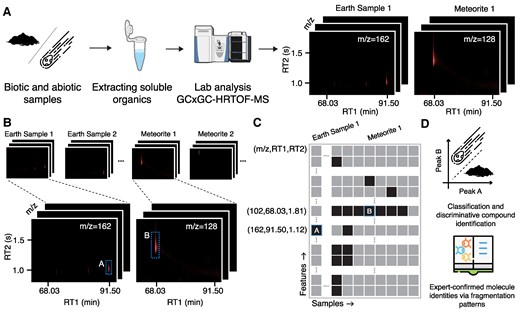
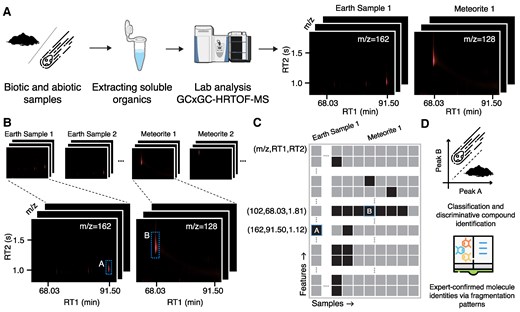
The LifeTracer workflow for collecting, curating, and analyzing the mass spectrometry data and developing a machine learning model for classifying samples. A) The soluble nonpolar and semipolar organics in 8 meteorites and 10 terrestrial geologic samples were analyzed using untargeted 2D gas chromatography coupled to high-resolution time-of-flight mass spectrometry (GC×GC-HRTOF-MS), resulting in total ion images (TIIs) in four dimensions corresponding to the mass-over-charge ratio (m/z), retention time in the first column (RT1), retention time in the second column (RT2), and intensity (abundance). This illustration shows the workflow for Meteorite 1 (Aguas Zarcas) and Earth Sample 1 (Iceland soil), with distinct peaks at m/z=162 and 102 amu, respectively. The device shown as a cartoon schematic to illustrate the instrument layout. B) High-intensity peaks in TIIs are extracted. Peaks may represent fragment ions originating from the same parent compound. C) Peaks are clustered and tabulated with rows representing features and columns representing samples. Black and gray squares indicate the presence or absence of features, respectively. In this illustration, the squares marked as A and B correspond to the peaks at m/z = 162 and 102 amu in Aguas Zarcas and Iceland soil samples. D) A logistic regression model is trained on the processed data to classify samples into the abiotic and biotic classes based on the composition of their organic compounds. Features with large regression coefficients are analyzed to identify the organic compounds that play a key role in distinguishing between biotic and abiotic samples. We manually analyzed the fragmentation patterns and exact masses in comparison to standards to determine the identity or candidate molecule type for each discriminative compound discovered by LifeTracer.

Abstract

With the upcoming sample return missions to the Solar System where traces of past, extinct, or present life may be found, there is an urgent need to develop unbiased methods that can distinguish molecular distributions of organic compounds synthesized abiotically from those produced biotically but were subsequently altered through diagenetic processes. We conducted untargeted analyses on a collection of meteorite and terrestrial geologic samples using 2D gas chromatography coupled with high-resolution time-of-flight mass spectrometry and compared their soluble nonpolar and semipolar organic species. To deconvolute the resulting large dataset, we developed LifeTracer, a computational framework for processing and downstream machine learning analysis of mass spectrometry data. LifeTracer identified predictive molecular features that distinguish abiotic from biotic origins and enabled a robust classification of meteorites from terrestrial samples based on the composition of their nonpolar soluble organics.

1700応用理学一般
ad
ad
Follow
ad
タイトルとURLをコピーしました